Healthy School Activation Program: A Physical Activity Education and Intervention Strategy to Reduce Sedentary Behaviour in Elementary Students
DOI:
https://doi.org/10.22437/jkam.v9i1.45900Keywords:
Educational Intervention, Elementary School Students, Healthy School, Physical Activity, Sedentary LifestyleAbstract
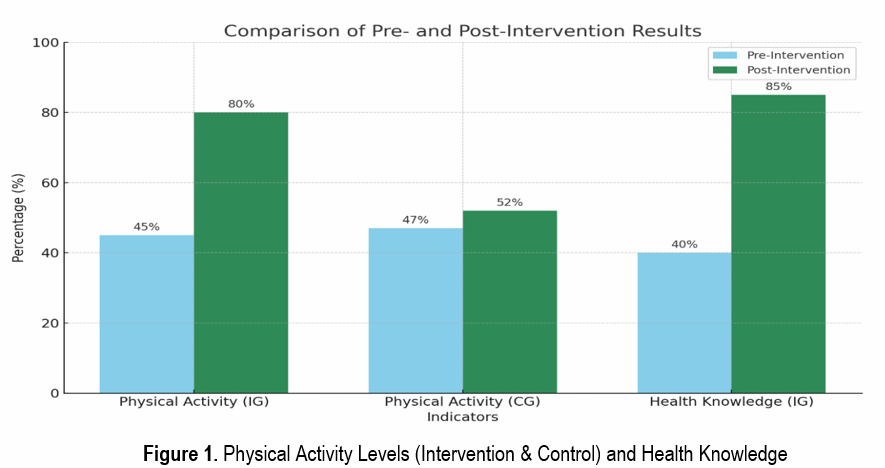
The Healthy School Activation program was designed to address the growing concerns of sedentary lifestyles, limited health knowledge, and low physical activity among elementary school students. It seeks to cultivate healthier behaviors, improve learning focus, and promote a collaborative school culture involving students, teachers, and parents. This qualitative study involved 120 fifth grade students from two elementary schools in Muara Bulian, divided into intervention and control groups. Ten teachers participated as key informants. Data collection methods included questionnaires, anthropometric assessments, and semi-structured interviews. The intervention led to a 35% increase in students' physical activity levels and improved health knowledge from 40% to 85%. A notable reduction in body mass index was observed among overweight students. Positive shifts were also reported in students’ attitudes toward physical activity, accompanied by enhanced focus and peer interaction in the classroom. Findings suggest that the program is effective in promoting active and healthy lifestyles among elementary students. The program adopts a collaborative strategy involving educators and families, providing a feasible model for promoting active lifestyles and fostering a supportive, health oriented school culture that can be implemented broadly and sustainably.
Downloads
References
Aman, M. S., Elumalai, G., Zamri, N. N. N., Ponnusamy, V., Mamat, S., Sharif, S., Ismail, H., Arshad, M. M., Suradi, N. R., & Imran, F. H. (2024). Sport, exercise, recreation and e-Sport participation in Malaysia. International Journal of Human Movement and Sports Sciences, 12(1), 78–83. https://doi.org/10.13189/saj.2024.120110
A’yunin, E. N., Fitriani, A., & Arroyyan, R. D. (2023). Health promotion of physical activity as an effort to overcome and prevent sedentary behavior in students [in Bahasa]. JMM (Jurnal Masyarakat Mandiri), 7(4), 3192. https://doi.org/10.31764/jmm.v7i4.15712
Chen, Y., Abidin, N. N. E. Z., & Aman, N. M. S. (2025). Improving intercultural communication in Chinese football clubs. Journal of International Students, 15(4), 119–152. https://doi.org/10.32674/3k9pgj53
D’Anna, C., Forte, P., & Pugliese, E. (2024). Trends in physical activity and motor development in young people—decline or improvement? a review. Children, 11(3), 298. https://doi.org/10.3390/children11030298
Donnelly, J. E., Hillman, C. H., Castelli, D., Etnier, J. L., Lee, S., Tomporowski, P., Lambourne, K., & Szabo-Reed, A. N. (2016). Physical activity, fitness, cognitive function, and academic achievement in children. Medicine & Science in Sports & Exercise, 48(6), 1197–1222. https://doi.org/10.1249/MSS.0000000000000901
Fajar, M., Putri, S. A. R., Nita, P., Norito, T. B., Wanto, S., & Lanos, M. E. C. (2022). Students’ perceptions of learning basic movements of 40 meter run athletic through traditional games. Halaman Olahraga Nusantara (Jurnal Ilmu Keolahragaan), 5(2), 576. https://doi.org/10.31851/hon.v5i2.7259
Goh, T. L., Moosbrugger, M., & Mello, D. (2020). Experiences of preservice and in-service teachers in a comprehensive school physical activity infusion curriculum. Education Sciences, 10(10), 290. https://doi.org/10.3390/educsci10100290
Grauduszus, M., Koch, L., Wessely, S., & Joisten, C. (2024). School-based promotion of physical literacy: A scoping review. Frontiers in Public Health, 12. https://doi.org/10.3389/fpubh.2024.1322075
Hanifah, L., Nasrulloh, N., & Sufyan, D. L. (2023). Sedentary behavior and lack of physical activity among children in Indonesia. Children, 10(8), 1283. https://doi.org/10.3390/children10081283
Hasan, H. A., Adi, S., Hariyanto, E., Khongrungchok, A., Oktaviani, H. I., & Fajarianto, O. (2023). Physical activity with play and game model to improve the cognitive of elementary school students. Edcomtech: Jurnal Kajian Teknologi Pendidikan, 8(1), 49. https://doi.org/10.17977/um039v8i12023p49
Hidayah, A. N., Rahmi, U., & Salasa, S. (2025). The relationship between knowledge about physical activity and anxiety levels in students with a sedentary lifestyle (Sedentary Lifestyle) [in Bahasa]. Jurnal Porkes, 8(2), 646-658. https://doi.org/10.29408/porkes.v8i2.30218
Kemenkes, R. I. (2018). The report on the results of the Basic Health Research (Riskesdas) Indonesia in 2018 [in Bahasa] Riset Kesehatan Dasar, 2018, 182-183. https://repository.badankebijakan.kemkes.go.id/id/eprint/3514/1/Laporan%20Riskesdas%202018%20Nasional.pdf
Kohl, H. W., Cook, H. D., Van Dusen, D. P., Kelder, S. H., Kohl, H. W., Ranjit, N., & Perry, C. L. (2013). Educating the study body: taking physical activity and physical education to school. Chapter 4: Physical Activity, Fitness, and Physical Education: Effects on Academic Performance. Journal of School Health, 81(2). https://www.ncbi.nlm.nih.gov/books/NBK201501/
Lanos, M. E. C., Lestari, H., Mahendra, A., Riyoko, E., Norito, T. B., Manullang, J. G., & Okilanda, A. (2022). Scientific article writing training for teachers at sman1 Tanjung Sakti Pumu, Lahat Regency [in Bahasa]. Wahana Dedikasi : Jurnal PkM Ilmu Kependidikan, 5(1), 81. https://doi.org/10.31851/dedikasi.v5i1.7178
Liu, Z., Xu, H.-M., Wen, L.-M., Peng, Y.-Z., Lin, L.-Z., Zhou, S., Li, W.-H., & Wang, H.-J. (2019). A systematic review and meta-analysis of the overall effects of school-based obesity prevention interventions and effect differences by intervention components. International Journal of Behavioral Nutrition and Physical Activity, 16(1), 95. https://doi.org/10.1186/s12966-019-0848-8
Megawati, R. N. N. S. (2021). The effect of sedentary behavior on obesity in school children [in Bahasa]. Jurnal_Kebidanan, 11(2), 651–661. https://doi.org/10.33486/jurnal_kebidanan.v11i2.152
Negara, N. J. C., Hamidie, A., & Paramitha, S. T. (2024). The effect of physical activity and sedentary behavior on children's mental health [in Bahasa]. Jurnal Pendidikan Olahraga, 14(3), 127–135. https://doi.org/10.37630/jpo.v14i3.1655
Norito, T. B., Dlis, F., Hanif, A. S., & Iqbal, M. (2019). Implementing cooperative learning in physical education and sport to improve children fundamental movement skill.. https://doaj.org/article/5cfe3f8f682745aea33dc95d4bbeae9c
Norito, T. B., Putri, S. a. R., Putra, D. D., & Fajar, M. (2022). Implementation of cooperative learning in improving basic motor skills in students aged 7-8 years [in Bahasa]. Jurnal Obsesi Jurnal Pendidikan Anak Usia Dini, 6(5), 3889–3900. https://doi.org/10.31004/obsesi.v6i5.2507
Nugraha, L., Mahendra, A., & Herdiyana, I. (2018). Application of movement education model in developing basic manipulative movement patterns through movement analysis framework [in Bahasa]. TEGAR Journal of Teaching Physical Education in Elementary School, 1(2), 24. https://doi.org/10.17509/tegar.v1i2.11935
Nurochim, N. (2020). Optimizing school health programs for student mental health [in Bahasa]. Jurnal Konseling Dan Pendidikan, 8(3), 184. https://doi.org/10.29210/141400
Pratiwi, I. D., Purwanto, E., Anggraeni, N. K. P., Rahmawati, F. F., Nuriyah, F., Fahril, I., & Robbi, M. J. A. (2025). Implementation of the "healthy school lunch" program as an effort to improve nutrition education for early childhood at TK ABA 37, Malang, East Java [in Bahasa]. Jurnal Abdi Masyarakat Indonesia, 5(4), 1251-1258. https://doi.org/10.54082/jamsi.1936
Riset Kesehatan Dasar (Riskesdas). (2018). 2018 National RISKESDAS report.pdf. in balitbangkes publishing institute (p. 156) [in Bahasa]. https://repository.badankebijakan.kemkes.go.id/id/eprint/3514/1/Laporan Riskesdas 2018 Nasional.pdf
Sallis, J. F., Prochaska, J. J., & Taylor, W. C. (2000). A review of correlates of physical activity of children and adolescents. Medicine & Science in Sports & Exercise, 32(5), 963–975. https://doi.org/10.1097/00005768-200005000-00014
Strong, W. B., Malina, R. M., Blimkie, C. J. R., Daniels, S. R., Dishman, R. K., Gutin, B., Hergenroeder, A. C., Must, A., Nixon, P. A., Pivarnik, J. M., Rowland, T., Trost, S., & Trudeau, F. (2005). Evidence based physical activity for school-age youth. The Journal of Pediatrics, 146(6), 732–737. https://doi.org/10.1016/j.jpeds.2005.01.055
Sufyan, D. L., & Sufyan, A. (2022). Activation of healthy lifestyle knowledge through balanced nutrition pillar education for non-health students [in Bahasa]. Jurnal Bakti Masyarakat Indonesia, 5(1). https://doi.org/10.24912/jbmi.v4i1.15231
Suharmanto, S. (2024). The relationship between social support and quality of life in students at the faculty of medicine, university of Lampung [in Bahasa]. Jurnal Kesehatan Tropis Indonesia, 2(4), 193–200. https://doi.org/10.63265/jkti.v2i4.99
Swinburn, B. A., Sacks, G., Hall, K. D., McPherson, K., Finegood, D. T., Moodie, M. L., & Gortmaker, S. L. (2011). The global obesity pandemic: Shaped by global drivers and local environments. The Lancet, 378(9793), 804–814. https://doi.org/10.1016/S0140-6736(11)60813-1
Wei, L., Aman, M. S., Abidin, N. E. Z., & Qian, W. (2025). Exploring the relationship between sports media use, sports participation behavior, and sport commitment: a mixed-methods study using structural equation modeling and qualitative insights. BMC Psychol 13, 636. https://doi.org/10.1186/s40359-025-02964-x
World Health Organization. (2020). WHO Guidelines on Physical Activity and Sedentary Behavior. Geneva: World Health Organization. Https://www.who.int/publications/i/item/9789240015128
Downloads
Published
How to Cite
Issue
Section
License
Copyright (c) 2025 Tri Bayu Norito, Mohd Salleh Aman, Kevin Waldo, Ayudya Suidarwanty Pratiwi, Ceppy Pradana

This work is licensed under a Creative Commons Attribution 4.0 International License.
Please find the rights and licenses in Jurnal Jurnal Karya Abdi Masyarakat (JKAM).
- License
The non-commercial use of the article will be governed by the Creative Commons Attribution license as currently displayed on Creative Commons Attribution 4.0 International License.
- Authors Warranties
The author warrants that the article is original, written by stated author(s), has not been published before, contains no unlawful statements, does not infringe the rights of others, is subject to copyright that is vested exclusively in the author and free of any third party rights, and that any necessary written permissions to quote from other sources have been obtained by the author(s).
- User Rights
JKAM's spirit is to disseminate articles published are as free as possible. Under the Creative Commons license, JKAM permits users to copy, distribute, display, and perform the work for non-commercial purposes only. Users will also need to attribute authors and JKAM on distributing works in the journal.
- Rights of Authors
Authors retain the following rights:
- Copyright, and other proprietary rights relating to the article, such as patent rights,
- The right to use the substance of the article in future own works, including lectures and books,
- The right to reproduce the article for own purposes, provided the copies are not offered for sale,
- The right to self-archive the article.
- Co-Authorship
If the article was jointly prepared by other authors, the signatory of this form warrants that he/she has been authorized by all co-authors to sign this agreement on their behalf, and agrees to inform his/her co-authors of the terms of this agreement.
- Termination
This agreement can be terminated by the author or JKAM upon two months notice where the other party has materially breached this agreement and failed to remedy such breach within a month of being given the terminating party notice requesting such breach to be remedied. No breach or violation of this agreement will cause this agreement or any license granted in it to terminate automatically or affect the definition of JKAM.
- Royalties
This agreement entitles the author to no royalties or other fees. To such extent as legally permissible, the author waives his or her right to collect royalties relative to the article in respect of any use of the article by JKAM or its sublicensee.
- Miscellaneous
JKAM will publish the article (or have it published) in the journal if the articles editorial process is successfully completed and JKAM or its sublicensee has become obligated to have the article published. JKAM may conform the article to a style of punctuation, spelling, capitalization, referencing and usage that it deems appropriate. The author acknowledges that the article may be published so that it will be publicly accessible and such access will be free of charge for the readers.