Development of Nata de Coco Product Marketing Strategy through Digital Marketing Pocket Book for Women Farmers Group in Pekik Nyaring Village
Keywords:
Agro-industry Development, Community Service, Marketing Strategy, Nata de Coco, Women Farmers GroupAbstract
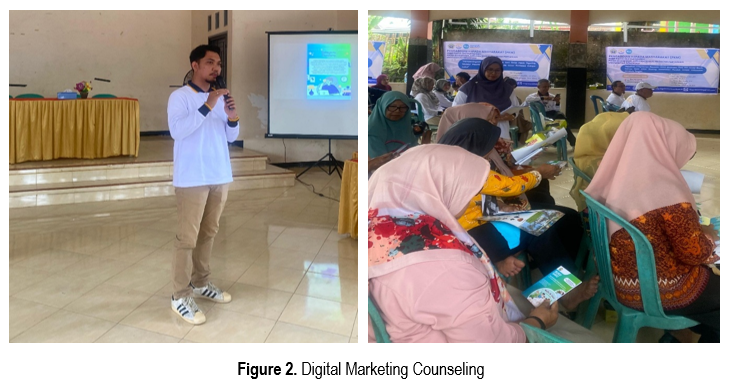
Pekik Nyaring Village is a village with abundant agricultural potential, especially coconut cultivation and agro-industry. In this village, the Women Farmers Group (KWT) plays a significant role in supporting the household economy through the production of coconut-based processed products, one of which is Nata de Coco. However, the resulting production faces challenges, namely limited marketing strategies. This community service aims to provide an understanding of digital marketing to the KWT. The methods used in this activity are counseling and discussions targeting the women farmers group of Pekik Nyaring village. The digital marketing counseling activity for nata de coco products in the KWT of Pekik Nyaring village has had a positive impact, this condition is reflected in the enthusiasm of the KWT participants in implementing the activity. In addition, the results of the evaluation related to the understanding of the counseling material showed a 28% increase in knowledge and the KWT was able to create a digital platform as a digital marketing platform. This condition can be the foundation for the success of community service activities. Similar activities should continue to be carried out sustainably with several methods such as live demonstrations and mentoring. This is done to ensure sustainable change
Downloads
References
Abraha, T. G., & Gebre, H. T. (2025). Assessment of performance and challenges of small and micro enterprises: Fireweyni town, Ethiopia. PLOS ONE, 20(4), e0320681. https://doi.org/10.1371/journal.pone.0320681
Budi, M. A., S, Andi, M., & Thoyib Maulana, M. (2025). Marketing technology and literacy as key drivers of SME market penetration. Journal of Innovation in Business and Economics, 9(01). https://doi.org/10.22219/jibe.v9i01.37060
Ayaz, D., Öncel, S., & Karadağ, E. (2022). The effectiveness of educational interventions aimed at agricultural workers’ knowledge, behaviour, and risk perception for reducing the risk of pesticide exposure: a systematic review and meta-analysis. International Archives of Occupational and Environmental Health, 95(6), 1167–1178. https://doi.org/10.1007/s00420-022-01838-8
Chaffey, D., & Ellis-Chadwik, F. (2019). Digital Marketing: Strategy and Implementation. Pearson Education.
Dwivedi, Y. K., Hughes, L., Ismagilova, E., Aarts, G., Coombs, C., Crick, T., Duan, Y., Dwivedi, R., Edwards, J., Eirug, A., Galanos, V., Ilavarasan, P. V., Janssen, M., Jones, P., Kar, A. K., Kizgin, H., Kronemann, B., Lal, B., Lucini, B., … Williams, M. D. (2021). Artificial Intelligence (AI): Multidisciplinary perspectives on emerging challenges, opportunities, and agenda for research, practice and policy. International Journal of Information Management, 57, 101994. https://doi.org/10.1016/j.ijinfomgt.2019.08.002
Fauziah, M., Noor, T. D. F. S., & Sujana, S. (2022). Overview of marketing engagement at Rainbow Hills Golf Club [in Bahasa]. Jurnal Aplikasi Bisnis Kesatuan, 2(3). https://doi.org/10.37641/jabkes.v2i3.1503
Hiremath, S. (2020). A study to evaluate the effectiveness of structured teaching programme on knowledge regarding selfprotective measures while spraying pesticides among farmers at selected rural areas, Tumkur. International Journal of Advance Research in Medical Surgical Nursing, 2(1), 01–04. https://doi.org/10.33545/surgicalnursing.2020.v2.i1a.26
Insi Nantika Jelita. (2023, December 4). BPS Says Agricultural Businesses Are Declining, Here's the Root Cause [in Bahasa]. Media Indonesia.
Jusoh, A., Hassan, A. A. G., Loganathan, N., Kogid, M., Latif, H. A., Zakaria, N. H., ... & Yazid, M. H. A. (2025). Empowering Smallholder Coconut Farmers Through E-Commerce: A Preliminary Study on Current Business Models, Opportunities, and Digital Readiness in Malaysia. Journal of Contemporary Management Studies, 1(1), 1-12.
Ihwan, K., Susanto, B. F., Surya, R. Z., Najamuddin, Ridwan M., & Badewin. (2025) Community service program (PKM) encourages increased exports of superior regional products of Indragiri Hilir Regency (coconut) through the utilization of digital marketing in MSMEs [in Bahasa]. TRIMAS: Jurnal Inovasi Dan Pengabdian Kepada Masyarakat, 5(1), 23–31. https://doi.org/10.58707/trimas.v5i1.1068
Khoo, H. E., Azlan, A., Tang, S. T., & Lim, S. M. (2017). Anthocyanidins and anthocyanins: colored pigments as food, pharmaceutical ingredients, and the potential health benefits. Food & Nutrition Research, 61(1), 1361779. https://doi.org/10.1080/16546628.2017.1361779
Khrais, L. T., & Gabbori, D. (2023). The effects of social media digital channels on marketing and expanding the industry of e-commerce within digital world. Periodicals of Engineering and Natural Sciences, 11(5), 64-75.
Lachaume, N. N. M. (2023). Improving patient experience scores in medical practice with patient centered blended education: Program design and evaluation. Carlos Albizu University.
Ma, X., & Gu, X. (2024). New marketing strategy model of E-commerce enterprises in the era of digital economy. Heliyon, 10(8).
Nunan, D., & Di Domenico, M. (2019). Older Consumers, Digital Marketing, and Public Policy: A Review and Research Agenda. Journal of Public Policy & Marketing, 38(4), 469–483. https://doi.org/10.1177/0743915619858939
Nurdin. (2014). The influence of extension methods and education level on environmental knowledge [in Bahasa]. Jurnal Ilmiah Pendidikan, 20(2), 201–206. https://doi.org/10.17509/mimbardik.v2i1.6021
Nurmilah, R., & Djakasaputra, A. (2024) optimizing the performance of culinary MSMEs: The relationship between internal aspects through customer engagement [in Bahasa]. Jurnal Manajerial Dan Kewirausahaan, 6(3), 641–648.
Sari, P. N., Andrayani, D., Melusi, Y., & Ramadhan, D. P. (2025). Financial literacy and digital marketing strategy workshop to increase MSME profits [in Bahasa]. Jurnal Abdimas Ilmiah Citra Bakti, 6(4), 1297–1310. https://doi.org/10.38048/jailcb.v6i4.5397
Schivinski, B., & Dabrowski, D. (2016). The effect of social media communication on consumer perceptions of brands. Journal of Marketing Communications, 22(2), 189–214. https://doi.org/10.1080/13527266.2013.871323
Selvakumar, P., Bhumbre, K. D., Prabu, G., Kuchipudi, J. D., TC, M., & Jayadeva, S. M. (2025). The impact of social media on food culture. In Food in the Metaverse and Web 3.0 Era: Intersecting Food, Technology, and Culture (pp. 267-286). IGI Global Scientific Publishing.
Suib, M. S., Yulianti, Shaleha, S. H., Laila, R. I. W. D., Mutiara, N., & Lestari, A. M. E. A. (2024). Digital marketing assistance for coconut products to improve the economy of village communities. Ihsanniat: Jurnal Pengabdian Kepada Masyarakat, 1(1), 34–41. https://doi.org/10.61181/ihsanniat.v1i1.449
Wiweko, A., & Anggara, A. W. (2025). A review of digital marketing practices among SMEs in Indonesia: Trends, challenges, and opportunities. International Research Journal of Economics and Management Studies IRJEMS, 4(5). https://10.56472/25835238/IRJEMS-V4I5P140
Yevseitseva, O., Liulchak, Z., Semenda, O., Järvis, M., & Ponomarenko, I. (2022). Digital-marketing as a modern tool for promotion of goods and services in social networks. Financial and credit activity: problems of theory and practice.
Yunita, D., Sekarningrum, B., & Gunawan, W. (2021). Education on the importance of water storage. Sawala: Jurnal Pengabdian Masyarakat Pembangunan Sosial, Desa Dan Masyarakat, 2(2), 114. https://doi.org/10.24198/sawala.v2i2.33408
Zurimi, S., Kaluku, S., & Bumbungan, A. (2020). Improving Knowledge and skills through counseling and basic life support simulation for the coastal community in Kasuari Hamlet, Asilulu Village, Leihitu District, Central Maluku Regency [in Bahasa]. PengabdianMu: Jurnal Ilmiah Pengabdian Kepada Masyarakat, 5(3), 264–269. https://doi.org/10.33084/pengabdianmu.v5i3.1129
Downloads
Published
How to Cite
Issue
Section
License
Copyright (c) 2026 Bembi Akbar Serawai, Melani Anisa Fitri, Septri Widiono, Alia Azmi, Faradiba F Zubedi

This work is licensed under a Creative Commons Attribution 4.0 International License.
Please find the rights and licenses in Jurnal Jurnal Karya Abdi Masyarakat (JKAM).
- License
The non-commercial use of the article will be governed by the Creative Commons Attribution license as currently displayed on Creative Commons Attribution 4.0 International License.
- Authors Warranties
The author warrants that the article is original, written by stated author(s), has not been published before, contains no unlawful statements, does not infringe the rights of others, is subject to copyright that is vested exclusively in the author and free of any third party rights, and that any necessary written permissions to quote from other sources have been obtained by the author(s).
- User Rights
JKAM's spirit is to disseminate articles published are as free as possible. Under the Creative Commons license, JKAM permits users to copy, distribute, display, and perform the work for non-commercial purposes only. Users will also need to attribute authors and JKAM on distributing works in the journal.
- Rights of Authors
Authors retain the following rights:
- Copyright, and other proprietary rights relating to the article, such as patent rights,
- The right to use the substance of the article in future own works, including lectures and books,
- The right to reproduce the article for own purposes, provided the copies are not offered for sale,
- The right to self-archive the article.
- Co-Authorship
If the article was jointly prepared by other authors, the signatory of this form warrants that he/she has been authorized by all co-authors to sign this agreement on their behalf, and agrees to inform his/her co-authors of the terms of this agreement.
- Termination
This agreement can be terminated by the author or JKAM upon two months notice where the other party has materially breached this agreement and failed to remedy such breach within a month of being given the terminating party notice requesting such breach to be remedied. No breach or violation of this agreement will cause this agreement or any license granted in it to terminate automatically or affect the definition of JKAM.
- Royalties
This agreement entitles the author to no royalties or other fees. To such extent as legally permissible, the author waives his or her right to collect royalties relative to the article in respect of any use of the article by JKAM or its sublicensee.
- Miscellaneous
JKAM will publish the article (or have it published) in the journal if the articles editorial process is successfully completed and JKAM or its sublicensee has become obligated to have the article published. JKAM may conform the article to a style of punctuation, spelling, capitalization, referencing and usage that it deems appropriate. The author acknowledges that the article may be published so that it will be publicly accessible and such access will be free of charge for the readers.