AI-Driven Teaching Capacity Building for English Teachers: A Professional Development Program for MGMP Tanjung Jabung Timur
Keywords:
Artifical Intelligence in Education, English Language Teaching, Professional Learning Community, Teacher Capacity Building, Technopedagogical CompetenceAbstract
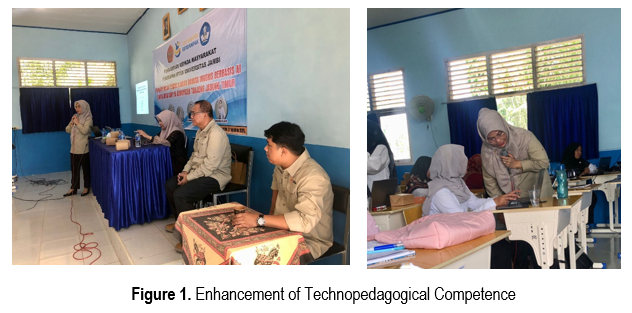
This community service program aimed to strengthen the technopedagogical competence of junior high school English teachers in Tanjung Jabung Timur Regency through the integration of Artificial Intelligence (AI) into classroom practice. The program adopted a participatory, needs-based approach involving 30 teachers from 12 schools and was implemented over seven weeks through workshops, mentoring, and classroom application. The training introduced AI concepts, ethical considerations, and hands-on use of selected applications, followed by guided implementation supported by reflective practice and continuous feedback. The results indicate notable improvements in teachers’ confidence and ability to design AI-integrated lessons, accompanied by increased student engagement and more interactive classroom dynamics. The program also contributed to a shift in teachers’ perceptions of AI from a perceived challenge to a supportive instructional partner and fostered the development of a professional learning community within the MGMP network. The novelty of this initiative lies in its mentoring-driven and practice-oriented approach tailored to rural educational contexts. The findings suggest that sustainable AI integration requires not only technical training but also ongoing professional support, collaborative structures, and alignment with local conditions.
Downloads
References
Adel, A. (2024). The convergence of intelligent tutoring, robotics, and IoT in smart education for the transition from industry 4.0 to 5.0. Smart Cities, 7(1), 325-369. https://doi.org/10.3390/smartcities7010014
Akram, H., Yingxiu, Y., Al-Adwan, A. S., & Alkhalifah, A. (2021). Technology integration in higher education during COVID-19: An assessment of online teaching competencies through technological pedagogical content knowledge model. Frontiers in psychology, 12, 736522. https://doi.org/10.3389/fpsyg.2021.736522
Allam, H. M., Gyamfi, B., & AlOmar, B. (2025). Sustainable innovation: Harnessing AI and living intelligence to transform higher education. Education Sciences, 15(4), 398. https://doi.org/10.3390/educsci15040398
Allayarova, S. U. (2025). Transformation in 21st century education: digital pedagogy and learner-centered teaching trends. International Journal Of Social Science & Interdisciplinary Research ISSN: 2277-3630 Impact factor: 8.036, 14(06), 132-146. https://www.gejournal.net/index.php/IJSSIR/article/view/2679
Asad, M. M., Aftab, K., Sherwani, F., Churi, P., Moreno-Guerrero, A. J., & Pourshahian, B. (2021). Techno‐pedagogical skills for 21st century digital classrooms: An extensive literature review. Education Research International, 2021(1), 8160084. https://doi.org/10.1155/2021/8160084
Barakina, E. Y., Popova, A. V., Gorokhova, S. S., & Voskovskaya, A. S. (2021). Digital Technologies and Artificial Intelligence Technologies in Education. European Journal of Contemporary Education, 10(2), 285-296. https://doi.org/10.13187/ejced.2021.2.285
Dȩbiec, P. (2017). Effective learner-centered approach for teaching an introductory digital systems course. IEEE Transactions on Education, 61(1), 38-45. https://doi.org/10.1109/te.2017.2729498
Dekhakhena, A. (2025). AI-powered personalized learning in EFL acquisition: Exploring adaptive instruction and feedback systems. Journal of Studies in Language, Culture and Society (JSLCS), 8(1), 111-131.
Duterte, J. P. (2024). Technology-enhanced learning environments: Improving engagement and learning. International Journal of Research and Innovation in Social Science, 8(10), 1305-131. https://doi.org/10.47772/ijriss.2024.8100111
Hockly, N. (2018). Blended Learning. ELT Journal, 72(1), 97-101. https://doi.org/10.1093/elt/ccx058
Holmes, W., Bialik, M., & Fadel, C. (2019). Artificial Intelligence In Education: Promises and Implications for Teaching and Learning. Boston: Center for Curriculum Redesign.
Jegede, O. O. (2024). Artificial intelligence and English language learning: Exploring the roles of AI-driven tools in personalizing learning and providing instant feedback. Universal Library of Languages and Literatures, 1(2). https://doi.org/10.70315/uloap.ullli.2024.0102002
Koehler, M. J., Mishra, P., & Cain, W. (2013). What is Technological Pedagogical Content Knowledge (TPACK)? Journal of Education, 193(3), 13–19. https://doi.org/10.1177/002205741319300303
Kukulska-Hulme, A. (2020). Mobile-assisted language learning [revised and updated]. In The Encyclopedia of Applied Linguistics (ed. C. A. Chapelle). Wiley.
Lagakos, D. (2020). Urban-rural gaps in the developing world: Does internal migration offer opportunities?. Journal of Economic perspectives, 34(3), 174-192. https://doi.org/10.1257/jep.34.3.174
Lata, P. (2024). Beyond algorithms: Humanizing artificial intelligence for personalized and adaptive learning. International Journal of Innovative Research in Engineering and Management, 11(5), 10-55524. https://doi.org/10.55524/ijirem.2024.11.5.6
Machumu, H., & Zhu, C. (2017). The relationship between student conceptions of constructivist learning and their engagement in constructivist based blended learning environments. International Journal of Learning Technology, 12(3), 253-272. https://doi.org/10.1504/ijlt.2017.088408
Mayrell, D. (2025). Enhancing Educator AI Literacy for Effective Use of Large Language Models: Exploring Teacher Usage and Professional Development (Doctoral dissertation, University of Louisiana at Monroe).
Mostert, F. G. (2024). Empowering teachers from marginalised communities through online professional development focussed on ICT use in under-resourced schools. University of Johannesburg (South Africa).
Muhlis, M., Ulfa, N. M., & Cahyono, A. E. (2025). Challenges of Economics Teachers in Implementing the Merdeka Curriculum. Journal of Educational Management Research, 4(6), 2880-2895. https://doi.org/10.61987/jemr.v4i6.1556
Pedro, F., Subosa, M., Rivas, A., & Valverde, P. (2019). Artificial intelligence in education: Challenges and opportunities for sustainable development. MINISTERIO DE EDUCACIÓN. https://hdl.handle.net/20.500.12799/6533
Rahimah, F., Faiza, G. R., & Noni, R. M. (2025). The Role of PGRI in Strengthening Educators’ Competencies Through the Continuing Professional Development Program. Jurnal Profesi Keguruan, 11(2), 112-125. https://doi.org/10.15294/jpk.v11i2.39940
Raza, A. (2025). Personalized learning through AI: opportunities and challenges in adaptive educational technologies. AI Edify Journal, 2(1), 21-28. https://researchcorridor.org/index.php/aiej/article/view/245
Rob, M., & Rob, F. (2018). Dilemma between constructivism and constructionism: Leading to the development of a teaching-learning framework for student engagement and learning. Journal of international education in business, 11(2), 273-290. https://doi.org/10.1108/JIEB-01-2018-0002
Sadaf, A., & Gezer, T. (2020). Exploring factors that influence teachers’ intentions to integrate digital literacy using the decomposed theory of planned behavior. Journal of Digital Learning in Teacher Education, 36(2), 124-145. https://doi.org/10.1080/21532974.2020.1719244
San Pablo-Palacio, P. J. G. (2025). Techno-Pedagogical Competence and Technology Integration Self-Efficacy of Public Elementary Teachers. International Journal of Open-Access, Interdisciplinary & New Educational Discoveries of ETCOR Educational Research Center. https://etcor.org/storage/iJOINED/Vol.%20IV(1),%20297-314.pdf
Downloads
Published
How to Cite
Issue
Section
License
Copyright (c) 2026 Fortunasari, Amirul Mukminin, Marzul Hidayat, M Gowon, Ella Masita, David Iqroni, Reny Heryanti

This work is licensed under a Creative Commons Attribution 4.0 International License.
Please find the rights and licenses in Jurnal Jurnal Karya Abdi Masyarakat (JKAM).
- License
The non-commercial use of the article will be governed by the Creative Commons Attribution license as currently displayed on Creative Commons Attribution 4.0 International License.
- Authors Warranties
The author warrants that the article is original, written by stated author(s), has not been published before, contains no unlawful statements, does not infringe the rights of others, is subject to copyright that is vested exclusively in the author and free of any third party rights, and that any necessary written permissions to quote from other sources have been obtained by the author(s).
- User Rights
JKAM's spirit is to disseminate articles published are as free as possible. Under the Creative Commons license, JKAM permits users to copy, distribute, display, and perform the work for non-commercial purposes only. Users will also need to attribute authors and JKAM on distributing works in the journal.
- Rights of Authors
Authors retain the following rights:
- Copyright, and other proprietary rights relating to the article, such as patent rights,
- The right to use the substance of the article in future own works, including lectures and books,
- The right to reproduce the article for own purposes, provided the copies are not offered for sale,
- The right to self-archive the article.
- Co-Authorship
If the article was jointly prepared by other authors, the signatory of this form warrants that he/she has been authorized by all co-authors to sign this agreement on their behalf, and agrees to inform his/her co-authors of the terms of this agreement.
- Termination
This agreement can be terminated by the author or JKAM upon two months notice where the other party has materially breached this agreement and failed to remedy such breach within a month of being given the terminating party notice requesting such breach to be remedied. No breach or violation of this agreement will cause this agreement or any license granted in it to terminate automatically or affect the definition of JKAM.
- Royalties
This agreement entitles the author to no royalties or other fees. To such extent as legally permissible, the author waives his or her right to collect royalties relative to the article in respect of any use of the article by JKAM or its sublicensee.
- Miscellaneous
JKAM will publish the article (or have it published) in the journal if the articles editorial process is successfully completed and JKAM or its sublicensee has become obligated to have the article published. JKAM may conform the article to a style of punctuation, spelling, capitalization, referencing and usage that it deems appropriate. The author acknowledges that the article may be published so that it will be publicly accessible and such access will be free of charge for the readers.