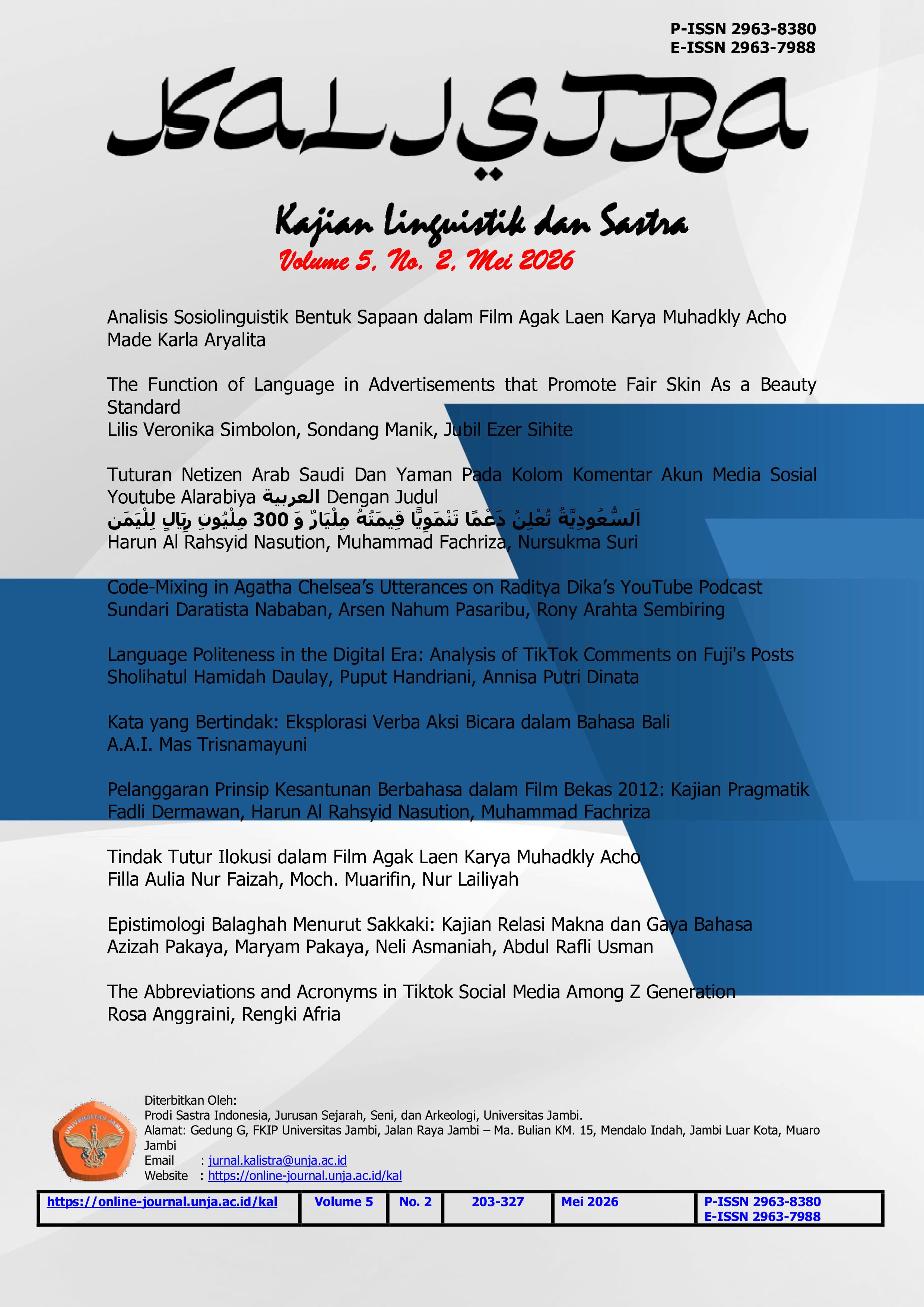
The Abbreviations and Acronyms in Tiktok Social Media Among Z Generation
DOI:
https://doi.org/10.22437/kalistra.v5i2.49624Keywords:
abbreviation, acronym, social media, tiktok, gen ZAbstract
The development of social media today, especially in the TikTok application, has given rise to new ways of communicating among Z Generation. One of them is the use of abbreviations and acronyms to facilitate communication and describe the characteristics of Z's identity generation. This study aims to analyse abbreviations and acronyms in communicating on the TikTok application by Z generation. The method used is descriptive qualitative by analysing comments and writings on TikTok. The results of this study show that Z generation uses abbreviations and acronyms to simplify and shorten communication on social media. The abbreviations and acronyms used are creative, flexible, and combined with foreign languages. This shows that without realizing it, communication patterns in social media have an impact on the formation of new words/terms.
Abstrak
Perkembangan media sosial saat ini terutama di aplikasi TikTok, memunculkan cara baru untuk berkomunikasi di kalangan generasi Z. Salah satu yang muncul adalah penggunaan singkatan dan akronim dalam mempermudah komunikasi serta menggambarkan karakteristik identitas generasi Z. Penelitian ini bertujuan untuk menganalisis singkatan dan akronim dalam berkomunikasi di aplikasi TikTok oleh generasi Z. Metode yang digunakan adalah deskriptif kualitatif dengan menganalisis komentar dan tulisan yang ada di TikTok. Hasil dari penelitian ini menunjukkan bahwa generasi Z menggunakan singkatan dan akronim untuk mempermudah dan mempersingkat berkomunikasi di media sosial. Singkatan dan akronim yang digunakan kreatif, fleksibel, dan dikombinasikan dengan Bahasa asing. Hal ini menunjukkan bahwa tanpa disadari pola komunikasi dalam media sosial berdampak dalam pembentukan kata/istilah baru.
Downloads
References
Adami, Elisabetta. (2026). Multimodal time–space-interaction analysis of content creators’ translocal trajectories. V (70), Discourse, Context & Media. https://doi.org/10.1016/j.dcm.2026.100977
Afandi, A. (2025). Pengembangan Bahan Ajar Singkatan dan Akronim Berbasis Kontekstual untuk Siswa Sekolah Dasar. Jurnal Evaluasi Dan Kajian Strategis Pendidikan Dasar, 2(2), 40–45. https://doi.org/10.54371/jekas.v2i2.902
Afdhaliyah, R., & Haq, S. C. (2021). Variasi Bahasa dalam Media Sosial Twitter. GHANCARAN: Jurnal Pendidikan Bahasa dan Sastra Indonesia, 3(1), 104-116. https://doi.org/10.19105/ghancaran.v3i1.4732
Afria, R., & Wahyudi, G. T. (2020). Analisis Bentuk Pemendekan Kata dalam Permainan DoTA 2: Analysis of Words Abbreviation Form in DoTA 2 Game. Jurnal Bastrindo, 1(2), 173-186. https://doi.org/10.29303/jb.v1i2.52
Al-Nashash, B. A.-A., & Altakhaineh, A. R. M. (2025). Analyzing the Impact of Social Media on the Development of Personality Speech at Different Stages of Ontogenesis. Preschool Education: Global Trends, 7, 7-38. https://doi.org/10.31470/2786-703X-2025-7-7-38
Anggita Cahyani, Andiopenta Purba, Arum Gati Ningsih, & Ade Kusmana. (2025). Analisis Penggunaan Bahasa Gaul Di Media Sosial Tiktok. Jurnal Bastra (Bahasa Dan Sastra), 10(4), 1361–1372. https://doi.org/10.36709/bastra.v10i4.1919
Astuti, N. (2014). Singkatan dan akronim di kalangan remaja di kota Bandung. Jurnal Bahtera Sastra Indonesia, 1(2). https://ejournal.upi.edu/index.php/BS_Antologi_Ind/article/view/516
Azizah, A. R. A. (2019). Penggunaan bahasa Indonesia dan bahasa gaul di kalangan remaja. Jurnal Skripta, 5(2).
Deliani, S., Zulkarnain, I., & Haekal Harahap, M. (2023). Akronim Bahasa Indonesia Dalam Perspektif Sosiolinguistik. Kongres Internasional Masyarakat Linguistik Indonesia, 2023, 249–255. https://doi.org/10.51817/kimli.v2023i2023.121
Fitrianingsih, R. A., Amilia, F., Kamila, D. F. R., & Sari, F. P. R. (2023). Akronim Bahasa Indonesia Pada Remaja. Jurnal Pendidikan Bahasa Indonesia, 11(2), 119-126. http://dx.doi.org/10.30659/jpbi.11.2.40-46
Maria, D. D. Y. K., Sam’ani, S. N. P., Putri, A. A. A., & Sarah, S. (2023). Analisis Pengaruh Penggunaan Bahasa Akronim dan Singkatan dari Twitter pada Kehidupan Sehari-hari. Artikulasi: Jurnal Pendidikan Bahasa dan Sastra Indonesia, 3(2), 104-111. https://doi.org/10.17509/artikulasi.v3i2.68512
Mutmainah, N., Herdiana, H., & Mulyani, S. (2025). Karakteristik Penggunaan Bahasa Gaul Dalam Media Sosial Tiktok Di Kalangan Generasi Z (Alternatif Pengembangan Bahan Ajar Teks Narasi). Diksatrasia: Jurnal Ilmiah Pendidikan Bahasa dan Sastra Indonesia, 9(2), 554-570. http://dx.doi.org/10.25157/diksatrasia.v9i2.19156
Muttaqin, N. A., Baehaqie, I., & Rustono, R. (2024). Bentuk-bentuk abreviasi bahasa gaul dalam media sosial Twitter: Suatu kajian morfologi. Lingua Rima: Jurnal Pendidikan Bahasa dan Sastra Indonesia, 13(2). http://dx.doi.org/10.31000/lgrm.v13i2.11815
Nicolaou, C. (2025). Advanced Technologies from and Through a Prototype Radio Lesson with Budding Journalists: The Views and Attitudes of Xers, Millennials, and Zoomers. Applied Sciences, 15(2), 588. https://doi.org/10.3390/app15020588
Pirdaus, D. I., & Vera, V. (2025). Media and Internet Linguistics: Language Transformation in Digital Communication. International Journal of Linguistics, Communication, and Broadcasting, 3(2), 50–56. https://doi.org/10.46336/ijlcb.v3i2.226
Santi, A., Mulyati, Y., & Hadianto, D. (2022). Bahasa Remaja Kaum Milenial: Bentuk Singkatan dan Pola Penggalan Kata dalam Media Sosial Twitter. HUMANIKA, 29(1), 91-105. https://doi.org/10.14710/humanika.v29i1.44741
Sokawati, F. R., Wardani, A. K., Ningsih, D. R., & Saptomo, S. W. (2025). Analisis Penggunaan Bahasa Gaul Dalam Media Sosial Tiktok. Lingua Rima: Jurnal Pendidikan Bahasa dan Sastra Indonesia, 14(2). http://dx.doi.org/10.31000/lgrm.v14i2.13825
Supartini, D., & Solihah, S. (2022). Penggunaan Abreviasi, Singkatan, dan Akronim dalam media WhatsApp di SMK Bina Sejahtera 1 Kota Bogor. Dewantara: Jurnal Pendidikan Sosial Humaniora, 1(3), 53-62. https://doi.org/10.30640/dewantara.v1i3.397
Downloads
Published
How to Cite
Issue
Section
License
Copyright (c) 2026 Rosa Anggraini, Rengki Afria

This work is licensed under a Creative Commons Attribution-ShareAlike 4.0 International License.
Kalistra: Kajian Linguistik dan Sastra is licensed under Creative Commons Attribution-ShareAlike 4.0 International License.

Authors who publish their manuscripts in Kajian Linguistik dan Sastra agree to the following terms:
1. The copyright in each article belongs to the author.
2. The author acknowledges that Kajian Linguistik dan Sastra reserves the right to be the first to publish under a Creative Commons Attribution-ShareAlike 4.0 International License (Attribution 4.0 International CC BY-SA 4.0).
3. Authors may submit articles separately, arranging for non-exclusive distribution of manuscripts that have been published in this journal to other versions (e.g., delivery to the author's institutional repository, publication into a book, etc.), acknowledging that the manuscript has been first published in Kajian Linguistik dan Sastra.