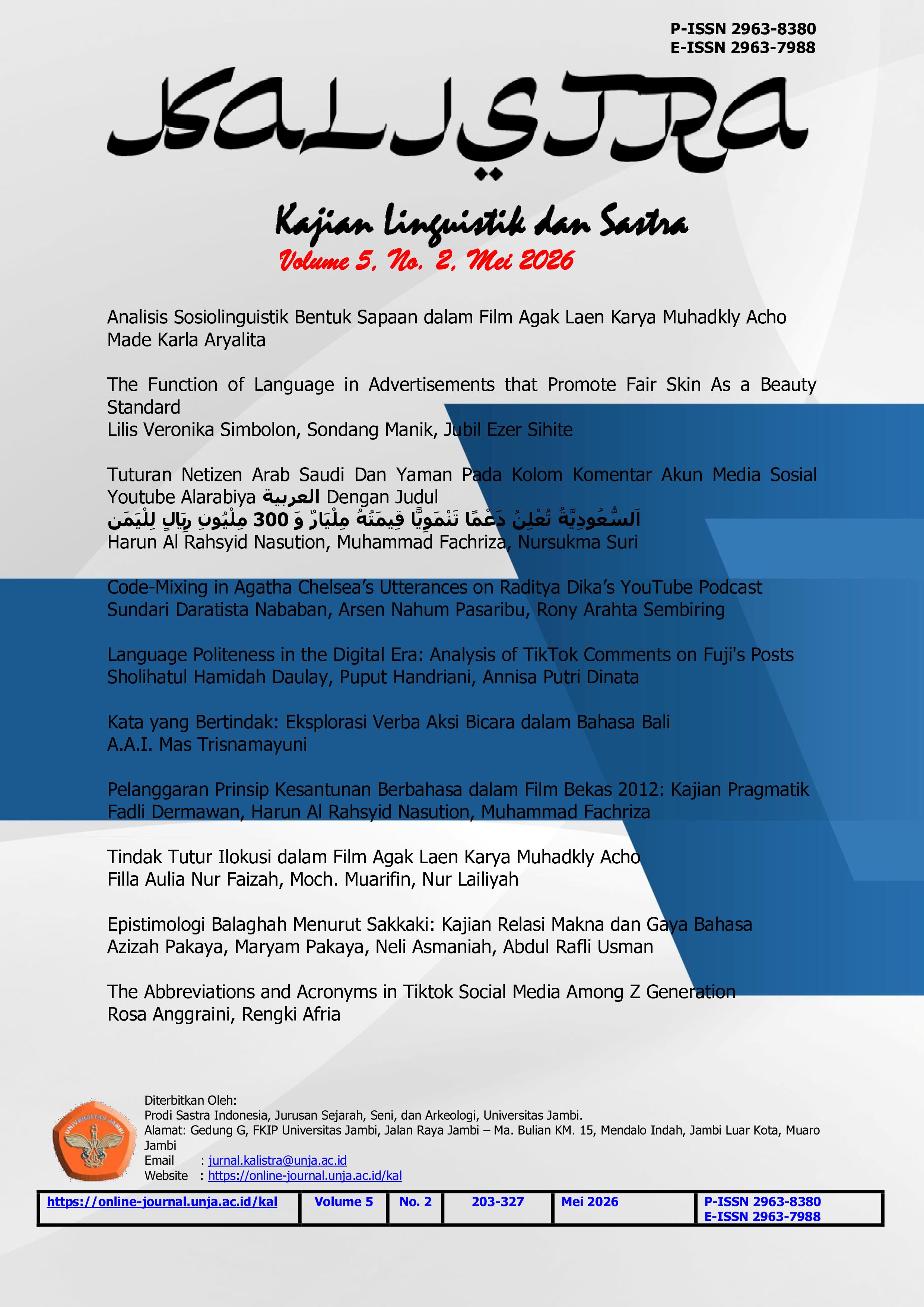
Kata yang Bertindak: Eksplorasi Verba Aksi Bicara dalam Bahasa Bali
DOI:
https://doi.org/10.22437/kalistra.v5i2.54013Keywords:
verba aksi, semantik, verba bicaraAbstract
This study examines speech action verbs in the Balinese language, which exhibit various forms and semantic meanings. The research is motivated by the uniqueness of Balinese, influenced by social stratification and dialectal variation affecting lexical usage. The objectives are to identify the groups and types of verbs meaning “to speak” and to describe their semantic structures. A qualitative method was applied using Balinese folktales as data sources, analyzed descriptively through verb classification theory and the Natural Semantic Metalanguage approach. The findings reveal five speech action verbs—mapangarah, mabesen, ngandika, matur, and ngerengkeng—which are categorized into two groups based on the presence or absence of a speech target. Semantically, these verbs generally follow a pattern where X performs an action toward Y, with differences in context, purpose, and social relations of the speakers.
Abstrak
Penelitian ini mengkaji verba aksi ‘bicara’ dalam bahasa Bali yang memiliki variasi bentuk dan makna semantis. Latar belakang penelitian ini didasarkan pada keunikan bahasa Bali yang dipengaruhi oleh sistem sosial serta variasi dialek yang memengaruhi penggunaan leksikon. Penelitian ini bertujuan untuk mengidentifikasi kelompok dan tipe verba bermakna ‘bicara’ serta mendeskripsikan struktur semantisnya. Metode yang digunakan adalah kualitatif dengan sumber data berupa cerita rakyat Bali, yang dianalisis secara deskriptif menggunakan teori klasifikasi verba dan pendekatan Metabahasa Semantik Alami. Hasil penelitian menunjukkan terdapat lima verba aksi ‘bicara’, yaitu mapangarah, mabesen, ngandika, matur, dan ngerengkeng, yang terbagi menjadi dua kelompok berdasarkan keberadaan sasaran bicara. Secara semantis, verba-verba tersebut memiliki pola umum tindakan dari X kepada Y dengan perbedaan pada konteks, tujuan, dan relasi sosial penutur.
Downloads
References
Adnyana, I. W. (2020). Analisis semantik verba dalam bidang perkebunan kopi dalam bahasa Bali. Jurnal Linguistik Indonesia, 38(2), 123–135.
Allan, K. (2016). The Routledge handbook of linguistics. London: Routledge.
Aryani, N. L. P., & Widiantana, I. N. (2022). Struktur semantik verba bidang pertanian dalam bahasa Bali: Kajian Natural Semantic Metalanguage. Jurnal Bahasa dan Budaya, 10(1), 45–58.
Givón, T. (1984). Syntax: A functional-typological introduction (Vol. 1). Amsterdam: John Benjamins.
Goddard, C. (1997). Semantic analysis: A practical introduction. Oxford: Oxford University Press.
Goddard, C., & Wierzbicka, A. (2014). Words and meanings: Lexical semantics across domains, languages, and cultures. Oxford: Oxford University Press.
Lestari, N. P. (2018). Verba ujaran dalam bahasa Bali: Kajian semantik dan tindak tutur. Jurnal Ilmu Bahasa, 14(2), 89–102.
Saputra, I. G. N., Putra, I. N. D., & Suparwa, I. N. (2020). Analisis semantik verba aksi “memukul” dalam bahasa Bali: Pendekatan Natural Semantic Metalanguage. Jurnal Kajian Bali, 10(1), 77–90.
Sudaryanto. (1993). Metode dan aneka teknik analisis bahasa. Yogyakarta: Duta Wacana University Press.
Sudipa, I. N. (2019). Ngaba and makta of Balinese action verbs: How to map their meanings. International Journal of Social Sciences and Humanities, 3(3), 72–80. https://doi.org/10.29332/ijssh.v3n3.377
Sudipa, I. N., Putra, I. N. D., & Suparwa, I. N. (2022). Semantic structures of Balinese speech act verbs: A Natural Semantic Metalanguage approach. Journal of Language and Linguistic Studies, 18(3), 1500–1515.
Suryasa, I. W. (2016). Ngalap in Balinese: A natural semantic metalanguage approach. Lingual, 6(1), 1–6.
Suryasa, I. W., & Dewi, A. A. S. (2018). Semantic structures in Balinese verbs: A natural semantic metalanguage perspective. International Journal of Linguistics, Literature and Culture, 4(5), 12–21.
Tama, I. W. (2022). Semantic components on sense of sight verbs in Balinese: An alternative in revitalizing language. In Prosiding Seminar Internasional Bahasa dan Sastra Daerah II (Sinar Bahtera II) (pp. 255–262).
Wierzbicka, A. (1996). Semantics: Primes and universals. Oxford: Oxford University Press.
Wierzbicka, A. (2010). Experience, evidence, and sense: The hidden cultural legacy of English. Oxford: Oxford University Press.
Downloads
Published
How to Cite
Issue
Section
License
Copyright (c) 2026 A.A.I. Mas Trisnamayuni

This work is licensed under a Creative Commons Attribution-ShareAlike 4.0 International License.
Kalistra: Kajian Linguistik dan Sastra is licensed under Creative Commons Attribution-ShareAlike 4.0 International License.

Authors who publish their manuscripts in Kajian Linguistik dan Sastra agree to the following terms:
1. The copyright in each article belongs to the author.
2. The author acknowledges that Kajian Linguistik dan Sastra reserves the right to be the first to publish under a Creative Commons Attribution-ShareAlike 4.0 International License (Attribution 4.0 International CC BY-SA 4.0).
3. Authors may submit articles separately, arranging for non-exclusive distribution of manuscripts that have been published in this journal to other versions (e.g., delivery to the author's institutional repository, publication into a book, etc.), acknowledging that the manuscript has been first published in Kajian Linguistik dan Sastra.