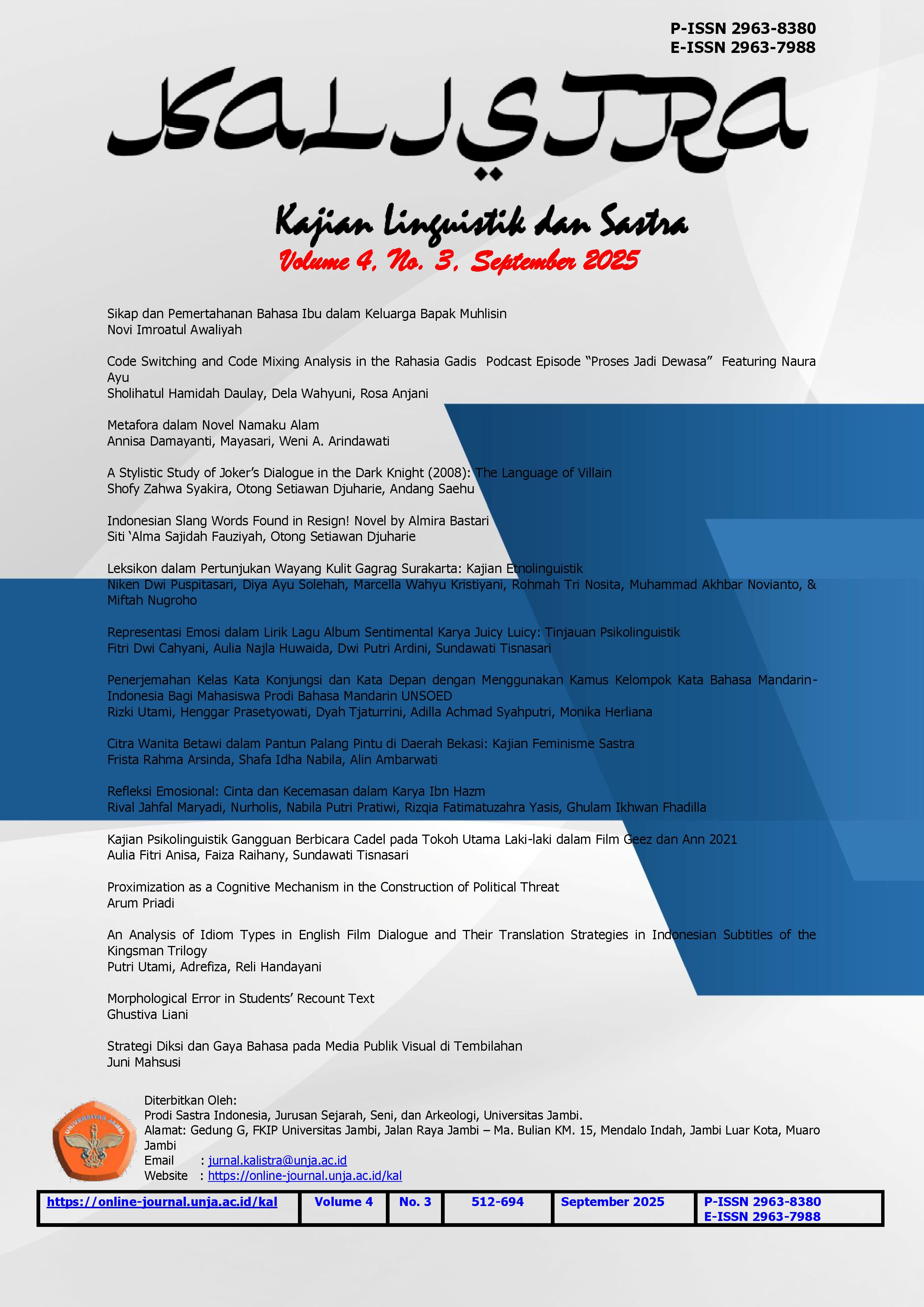
Code Switching and Code-Mixing Analysis in the Rahasia Gadis Podcast Episode “Proses Jadi Dewasa” Featuring Naura Ayu
DOI:
https://doi.org/10.22437/kalistra.v4i3.44207Kata Kunci:
code-switching, code mixing, sociolinguistics, podcast, Rahasia gadis, Naura AyuAbstrak
This research discusses code-switching and code-mixing in the podcast Rahasia Gadis with Naura Ayu, especially in the episode Proses jadi dewasa. Using a descriptive qualitative method and sociolinguistic approach, this study found that the most dominant form of code switching is intra sentential switching, followed by code mixing in words, phrases, and clauses. These bilingual elements clarify meaning, show social identity, and create a relaxed and personalized atmosphere between the speaker and the listener. The findings reveal that code-switching and code-mixing reflect bilingual ability and become communication tools that enrich conversations, making them more interactive and relevant in digital media.
Abstrak
Penelitian ini membahas alih kode dan campur kode dalam podcast Rahasia Gadis bersama Naura Ayu, khususnya pada episode Proses jadi dewasa. Dengan menggunakan metode kualitatif deskriptif dan pendekatan sosiolinguistik, penelitian ini menemukan bahwa bentuk pergantian kode yang paling dominan adalah pergantian kode dalam satu kalimat, diikuti oleh campuran kode pada kata, frasa, dan klausa. Elemen bilingual ini memperjelas makna, menunjukkan identitas sosial, dan menciptakan suasana yang santai dan personal antara pembicara dan pendengar. Temuan ini menunjukkan bahwa code-switching dan code-mixing mencerminkan kemampuan bilingual dan menjadi alat komunikasi yang memperkaya percakapan, membuatnya lebih interaktif dan relevan di media digital.
Unduhan
Referensi
Afria, R. (2016). Peristiwa Tutur, Campur Kode, dan Alih Kode Antara Pedagang dan Pembeli di Pasar Tanjung Bajure Kota Sungai Penuh. Tsaqofah dan Tarikh: Jurnal Kebudayaan dan Sejarah Islam, 1(2), 143-154. http://dx.doi.org/10.29300/ttjksi.v1i2.722
Aini, N., Suherdi, D., & Lubis, F. (2024). Types and Functions of Code Mixing in “Makna Talks” Podcast. Variable Journal, 6(1), 13–25
Daulay, S. H. (2019). The Using of Emoticon in BBM Status. AL-IRSYAD: Jurnal Pendidikan dan Konseling, 6(2).
Daulay, S. H., Bahar, T., Putri, A., & Batubara, P. F. (2023). Various wordings of propaganda on social media: Cases from Instagram application. Journal of Linguistics, Literacy, and Pedagogy, 2(2), 100-107.
Daulay, S. H., Nst, A. H., Ningsih, F. R., Berutu, H., Irham, N. R., & Mahmudah, R. (2024). Code switching in the social media era: A linguistic analysis of Instagram and TikTok users. Humanitatis: Journal of Language and Literature, 10(2), 373-384.
Daulay, S. H., Rizky, F. M., & Lubis, R. A. (2025). From Tweets to Tension: How Language Shape Hoaxes and Hatred in the Twitterverse. Kajian Linguistik dan Sastra, 4(2), 339-346.
Daulay, S.H. (2014). Types of code mixing on the Facebook status. The 2nd ELITE International Conference, Vol. 38, 365–371.
Daulay, SH., (2019). Language and Society. Medan: Lembaga Peduli Pengembangan Pendidikan Indonesia (LPPPI). ISBN. 978-623-90653-3-1
Dewi Ayu, S. (2024). An analysis code mixing and code switching on podcast PUELLA ID channel [Undergraduate thesis, Universitas Muhammadiyah Sumatera Utara]
Dewirahmamanirwati, D., & Aditiawarman, M. (2023). From bilingualism to code mixing and code switching uttered by Indonesian youth. Scientific Journal of Langue and Parole, 6(2), 71–91
Endriani, H., Ernanda, E., & Afria, R. (2023). Alih Kode Dialek Kecamatan Danau Kerinci dengan Bahasa Korea: Studi Kasus pada Penggemar Budaya Korea. Kajian Linguistik Dan Sastra, 2(3), 293-304. https://doi.org/10.22437/kalistra.v2i3.24358
Fatmawati, D. A. Y. U., Arsanti, M., & Chamalah, E. V. I. (2022). Code switching and code mixing in Musyawarah podcast on Najwa Shihab’s YouTube channel. Jurnal Pendidikan Bahasa Indonesia, 11(1), 21–36
Goddess, B. D. (2024). Types of code switching found in podcast Friends of Merry Riana by Naura Ayu and Merry Riana. Linguistics: Journal of Language and Literature, 9(1)
Muysken, P. (2000). Bilingual speech: A typology of code-mixing. Cambridge University Press
Permana, L. I., & Laila, M. (2023). Analysis of code-mixing found in the Corbuzier Podcast on YouTube. Linguistic and Literature Study, 5(2)
Poplack, S. (1980). Sometimes I’ll start a sentence in Spanish y termino en español: Toward a typology of code-switching. Linguistics, 18(7–8), 581–618
Pradina, F. A. (2021). Code-switching as media speech: An Evidence in Indonesian podcast. The Direction of Cultural Literature, 5(1)
Sari, R., Lubis, A. K., & Daulay, S. H. (2024). Facts and Features of Human Language in Social Media: Interaction and Culture of Alpha Generation. Journal of English Language Teaching, Linguistics, and Literature Studies, 4(2), 108-121.
Suwastini, N. K. A., Anggara, I. P. D., Mahendrayana, G., & Mahayanti, N. W. S. (2024). Unveiling functions and patterns of intra-sentential code- switching in the video podcast ‘Culture Shock Kuliah di Inggris’ on YouTube channel. TARBIYA: Journal of Education in Muslim Society, 11(2), 135–158
Waruwu, E. D., Zebua, M., & Harefa, A. M. (2023). Code switching and code mixing in the “Cape Mikir with Jebung” podcast on Spotify: A sociolinguistic analysis. Enggang: Journal of Education, Language, Literature, Arts, and Culture, 3(2), 115–123
Wiranda, A., Alqawwiy, T. A., & Daulay, S. H. (2024). Identifying Swear Words Uttered by Indonesia Gamer on Live Streaming. JALC: Journal Of Applied Linguistic and Studies of Cultural, 2(2), 1-12.
Unduhan
Diterbitkan
Cara Mengutip
Terbitan
Bagian
Lisensi
Hak Cipta (c) 2025 Sholihatul Hamidah Daulay, Dela Wahyuni, Rosa Anjani

Artikel ini berlisensiCreative Commons Attribution-ShareAlike 4.0 International License.
Kalistra: Kajian Linguistik dan Sastra is licensed under Creative Commons Attribution-ShareAlike 4.0 International License.

Authors who publish their manuscripts in Kajian Linguistik dan Sastra agree to the following terms:
1. The copyright in each article belongs to the author.
2. The author acknowledges that Kajian Linguistik dan Sastra reserves the right to be the first to publish under a Creative Commons Attribution-ShareAlike 4.0 International License (Attribution 4.0 International CC BY-SA 4.0).
3. Authors may submit articles separately, arranging for non-exclusive distribution of manuscripts that have been published in this journal to other versions (e.g., delivery to the author's institutional repository, publication into a book, etc.), acknowledging that the manuscript has been first published in Kajian Linguistik dan Sastra.