Antibacterial Activity of Combination of Betel Leaf Extract and Star Fruit Using Hydroextraction Method
DOI:
https://doi.org/10.22437/chp.v6i4.21736Keywords:
Antibacterial, Averrhoa bilimbi L, Hydroextraction, Piper betleAbstract
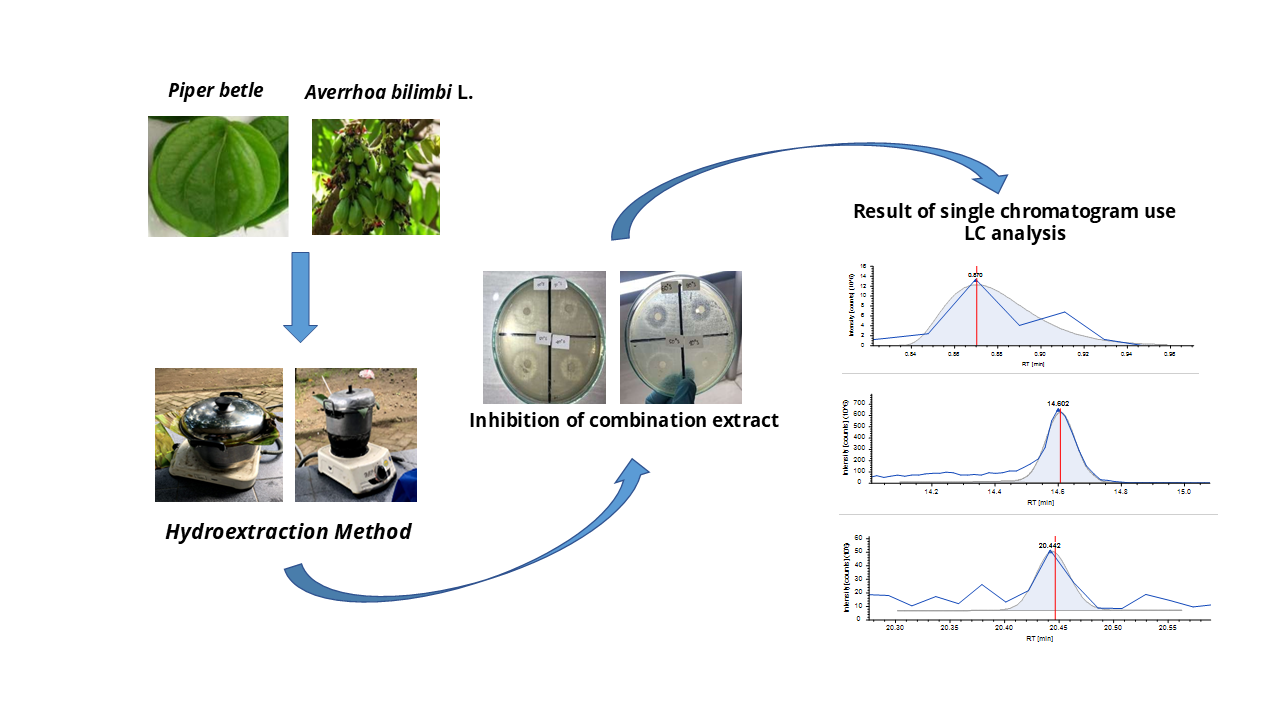
Antibacterial compounds are bioactive substances capable of inhibiting bacterial growth by disrupting the metabolism and cellular processes of pathogenic microorganisms. Natural plant-derived compounds have been widely explored for their antibacterial properties, with star fruit (Averrhoa bilimbi L.) and betel leaf (Piper betle) recognized for their potent antimicrobial effects. This study aimed to evaluate the antibacterial activity of a combination of star fruit and betel leaf extracts against Escherichia coli and Staphylococcus aureus, two clinically significant bacterial pathogens. The extraction process was performed using hydro-extraction at different temperatures (40°C, 50°C, 60°C, and 90°C) to determine the optimal conditions for bioactive compound yield. Antibacterial activity was assessed using the disc diffusion method, measuring inhibition zones to indicate bacterial susceptibility. The results demonstrated that the optimal inhibitory effect occurred at 50°C, producing an inhibition zone of 19.75 mm for Staphylococcus aureus and 11.75 mm for Escherichia coli. These findings suggest that temperature plays a critical role in maximizing the antibacterial potential of plant extracts. The study highlights the potential application of star fruit and betel leaf extracts as natural antibacterial agents, particularly against Gram-positive and Gram-negative bacteria. Further research is recommended to explore the mechanism of action, phytochemical composition, and potential synergy of these extracts in antimicrobial formulations.
Downloads
References
[1] Rustanti, E., Jannah, A., & Fasya, A. G. (2013). Uji Aktivitas Antibakteri Senyawa Katekin Dari Daun Teh (Cameliasinensis L.Var Assamica) Terhadap Bakteri Micrococcusluteus. Alchemy, 2(2). https://doi.org/10.18860/al.v0i0.2886
[2] Maryam, S., Juniasti, S., & Kosman, R. (2015). Uji Aktivitas Antibakteri Ekstrak Etanol Buah Belimbing Wuluh (Averrhoa Bilimbi L.) Asal Kota Watampone. Jurnal Ilmiah As-Syifaa, 7(1), 60–69. https://doi.org/10.33096/jifa.v7i1.21
[3] Ferdyani, S., Yuniarto, P. F., (2020). Uji Aktivitas Antibakteri Sediaan Gel Ekstrak Etanol Buah Belimbing Wuluh (Averrhoa Bilimbi Linn) terhadap Bakteri Staphylococcus aureus. Jurnal Kesehatan Mahasiswa UNIK, 2(1), 30–42.
[4] Ngajow, M., Abidjulu, J., & Kamu, V. S. (2013). Pengaruh Antibakteri Ekstrak Kulit Batang Matoa (Pometia pinnata) terhadap Bakteri Staphylococcus aureus secara In vitro. Jurnal MIPA, 2(2), 128. https://doi.org/10.35799/jm.2.2.2013.3121
[5] Dewi, L.K., Sarosa, A.H., Kartikowati, C.W., Hayati, N., Parasu, R., Amalia, E. (2021). Pengaruh Jenis Pelarut Terhadap Daya Antibakteri Hasil Ekstraksi Daun Sirih Hijau (Piper betle L.) pada Aktivitas Staphylococcus Epidermidis. Journal of Innovation and Applied Technology. Vol. 7 (1). OI: http://dx.doi.org/10.21776/ub.jiat.2021.007.01.6
[6] Noventi, W. R.-4272-2-P. pdfa., & Carolia, N. (2016). Potensi Ekstrak Daun Sirih Hijau ( Piper betle L .) sebagai Alternatif Terapi Acne vulgaris. Studi Pendidikan Dokter Fakultas Kedokteran Universitas Lampung, Vol. 5(1), Hal. 140.
[7] Triyani, M. A., Pengestuti, D., Khotijah, S. L., Susilaningrum, D. F., & Ujilestari, T. (2021). Aktivitas Antibakteri Hand Sanitizer Berbahan Ekstrak Daun Sirih dan Ekstrak Jeruk Nipis. NECTAR: Jurnal Pendidikan Biologi, 2(1), 16-23
[8] Bagus, I., Suyasa, O., Bekti, H. S., Rinawati, L. P., & Laksmi, L. P. (2022). Daya Hambat Ekstrak Daun Sirih dan Daun Legundi Terhadap Pertumbuhan Bakteri Staphylococcus aureus. 1(5). The Journal Of Muhammadiyah Medical Laboratory Technologist.
[9] Aji, A., & Bahri, S. (2017). Pengaruh Waktu Ekstraksi Dan Konsentrasi HCl untuk Pembuatan Pektin dari Kulit Jeruk Bali (Citrus maxima). Jurnal Teknologi Kimia Unimal, 6(1), 33–44.
[10] Rahayu, N. W. S., Prasetyo, E. N., & Isdiantoni. (2016). Hindroekstraksi Daun Ketapang (Terminalia catappa L.) sebagai Pengendali Penyakit Ice-ice pada Budidaya Kappaphycus alvarezii. Jurnal Sains Dan Seni Its, 1–8.
[11] Indrayati, A., Farmasi, F., Buana, U., Karawang, P., & Pudding, S. (2019). Formulasi , Uji Stabilitas Fisik Dan Kompatibilitas Produk Kosmetik Anti-Aging Dalam Sediaan Serum. Jurnal Ilmiah Farmasi, 4, 2.
[11] Muthmainnah. (2017). Skrining Fitokimia Senyawa Metabolit Sekunder Dari Ekstrak Etanol Buah Delima (Punica Granatum L.) Dengan Metode Uji Warna. Media Farmasi, 13(3), 1576–1580.
[12] Harborne, J.B. (2006). Metode Fitokimia: Penuntun Cara Modern Menganalisis Tumbuhan (alih bahasa: Kosasih Padmawinata & Iwang Soediro). Bandung : Penerbit ITB.
[13] Dewi, N. R. K., Kuncoro, H., & Rijai, L. (2015). Potensi Sitotoksik Ekstrak Air Daun Sirih Hitam (Piper sp.). Jurnal sains dan Kesehatan, 1(1), 11-15.
[14] Dewantoro, Z., Widodo, Y.L.A., Ciptaningtyas, R. (2017). Pengaruh Pemberian Ekstrak daun Belimbing Wuluh (Averrhoa bilimbi L). Terhadap Pertumbuhan Bakteri Staphylococcus aureus secara In Vitro. Jurnal Kedokteran Diponegoro, 6(2); 886-892
[15] Parama, P. W., Sukrama, I. D. M., & Handoko, S. A. (2019). Uji efektifitas antibakteri ekstrak buah jeruk nipis (Citrus aurantifolia) terhadap pertumbuhan Streptococcus mutans in vitro. Bali dental journal, 3(1), 45-52.
[16] Nuria, M.C., A. Faizatun., dan Sumantri. 2009. Uji Antibakteri Ekstrak Etanol Daun Jarak Pagar (Jatropha cuircas L) terhadap Bakteri Staphylococcus aureus ATCC 25923, Escherichia coli ATCC 25922, dan Salmonella typhi ATCC 1408. Jurnal Ilmu –Ilmu Pertanian. 5: 26 –37.
[17] Isnarianti, R., Wahyudi, I. A., & Puspita, R. M. (2013). Muntingia calabura L leaves extract inhibits glucosyltransferase activity of Streptococcus mutans. Journal of Dentistry Indonesia, 20(3), 59-63.
[18] Matilla-Cuenca, L., Gil, C., Cuesta, S. et al. Antibiofilm activity of flavonoids on staphylococcal biofilms through targeting BAP amyloids. Sci Rep 10, 18968 (2020). https://doi.org/10.1038/s41598-020-75929-2
[19] Shamsudin NF, Ahmed QU, Mahmood S, Ali Shah SA, Khatib A, Mukhtar S, Alsharif MA, Parveen H, Zakaria ZA. Antibacterial Effects of Flavonoids and Their Structure-Activity Relationship Study: A Comparative Interpretation. Molecules. 2022 Feb 9;27(4):1149. doi: https://doi.org/10.3390/molecules27041149
[20] Yan Y, Li X, Zhang C, Lv L, Gao B, Li M. Research Progress on Antibacterial Activities and Mechanisms of Natural Alkaloids: A Review. Antibiotics (Basel). 2021 Mar 19;10(3):318. doi: https://doi.org/10.3390/antibiotics10030318.
[21] Vaou N, Stavropoulou E, Voidarou C, Tsigalou C, Bezirtzoglou E. Towards Advances in Medicinal Plant Antimicrobial Activity: A Review Study on Challenges and Future Perspectives. Microorganisms. 2021 Sep 27;9(10):2041. doi: https://doi.org/10.3390/microorganisms9102041
[22] Redondo LM, Chacana PA, Dominguez JE, Fernandez Miyakawa ME. Perspectives in the use of tannins as alternative to antimicrobial growth promoter factors in poultry. Front Microbiol. 2014 Mar 27;5:118. doi: https://doi.org/10.3389/fmicb.2014.00118
[23] Sari, D. R. A. P., Yustiantara, P. S., Paramita, N. L. P. V., & Wirasuta, I. M. A. G. (2014). Uji Aktivitas Antibakteri Ekstrak Etanol Buah Lada Hitam (Piper nigrum L.) Terhadap Bakteri Propionibacterium acnes. Jurnal Farmasi Udayana, 3(2), 279831.
[24] Tarigan, I., Muadifah, A., & Latief, M. (2023). Non-Ribosomal Inhibition of The Antibacterial Compound from Ethanol Extract of Gnetii gnemon. Life Science, 12(2), 174-185. https://doi.org/10.15294/lifesci.v12i2.67183
Published
Versions
- 2026-02-24 (2)
- 2022-12-31 (1)