Formulation and Characterization of Microencapsules Containing Ethanol Extract of Sungkai Leaves (Peronema canescens Jack)
DOI:
https://doi.org/10.22437/chp.v9i1.43042Keywords:
Coating agent, microencapsulation, ethanol extract, SungkaiAbstract
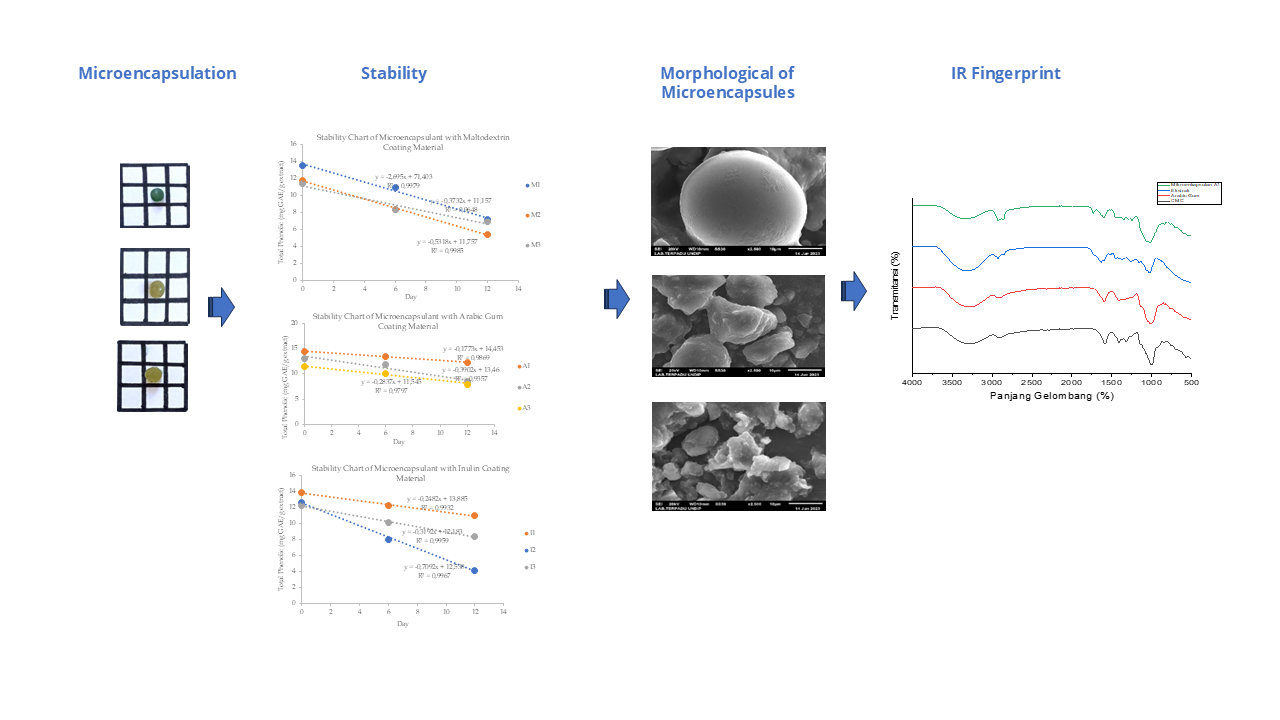
The Sungkai plant (Peronema canescens Jack) is a widely recognized medicinal plant in Indonesia, with its leaves recently gaining attention for their potential health benefits. This study explores the microencapsulation of ethanol extract from Sungkai leaves using three different coating materials—maltodextrin, inulin, and Arabic gum—at varying concentrations. The aim of this study was to identify the optimal microencapsulation formulation using these materials. Microencapsulation was performed using the extrusion method, and the best formulation was characterized by evaluating its physicochemical properties, morphology, and infrared (IR) spectrum. Antioxidant activity was measured using the 2,2-diphenyl-1-picrylhydrazyl (DPPH) assay. The results showed that microencapsulant formulation A1 exhibited superior physicochemical properties compared to other formulations. Scanning electron microscopy (SEM) analysis of sample A1 revealed a smooth surface with a slightly rounded shape and minimal wall folds or cracks, suggesting good stability. Fourier-transform infrared (FTIR) analysis confirmed effective encapsulation of the ethanol extract. While the crude extract demonstrated the highest antioxidant activity, microencapsulation slightly reduced this activity. Among the microencapsulated samples, formulation A1 (using Arabic gum) retained the most antioxidant potential. In conclusion, formulation A1, utilizing Arabic gum as the coating material, was found to be the optimal microencapsulation formulation for the ethanol extract of Sungkai leaves.
Downloads
References
[1]. Latief M, Lizawati, Tarigan IL, Muhaimin, Sari PM. Screening of antibiotic candidates from nine medicinal plants Jambi Province. In: AIP Conference Proceedings. Vol 080004. ; 2023.
[2]. Ningsih A, Ibrahim A. Aktivitasi Antimikroba Ekstrak Fraksi n-heksan daun Sungkai (Peronema canescens. Jack) terhadap beberapa bakteri dengan metode KLT-Bioautografi. Journal of Tropical Pharmacy and Chemistry. 2013;2(2):76-82. doi:10.25026/jtpc.v2i2.51
[3]. Latief M, Sari PM, Fatwa LT, Tarigan IL, Rupasinghe HPV. Antidiabetic Activity of Sungkai (Peronema canescens Jack) Leaves Ethanol Extract on the Male Mice Induced Alloxan Monohydrate. Pharmacology and Clinical Pharmacy Research. 2021;6(2):64. doi:10.15416/pcpr.v6i2.31666
[4]. Latief M, Tarigan IL, Sari PM, Aurora FE. Aktivitas Antihiperurisemia ekstrak Etanol Daun Sungkai (Peronema canescens Jack) Pada Mencit Putih Jantan. Pharmacon Jurnal Farmasi Indonesia. 2021;18(1):23-37. doi:10.23917/pharmacon.v18i01.12880
[5]. Tarigan IL, Sutrisno S, Rumaida R, Aini IPS, Latief M. Isolation of a Flavone Apigenin and a Steroids Squalene from Peronema canescens Jack Leaves with Anti-Inflammatory Activities. Pharmacognosy Journal. 2022;14(6):744-752. doi:10.5530/pj.2022.14.162
[6]. Fikriansyah M, Nelson, Latief M, Tarigan IL. Anticancer activities of seven Peronemins (A2, A3, B1, B2, B3, C1, and D1) from Peronema canescens Jack: A prediction studies. Chempublish Journal. 2023;7(1):54-63. doi:10.22437/chp.v7i1.23726
[7]. Nurjannah S, Arum D, Tarigan IL, Latief M. Anti-Inflammatory prediction of Peronemin compounds from Sungkai (Peronema canescens Jack) and their derivatives. Al Ulum Jurnal Sains dan Teknologi. 2023;9(2):59-66.
[8]. Bamidele OP, Emmambux MN. Encapsulation of bioactive compounds by “extrusion” technologies: a review. Critical Reviews in Food Science and Nutrition. 2021;61(18):3100-3118. doi:10.1080/10408398.2020.1793724
[9]. Šeregelj V, Ćetković G, Čanadanović-Brunet J, Tumbas Šaponjac V, Vulić J, Stajčić S. Encapsulation and degradation kinetics of bioactive compounds from sweet potato peel during storage. Food Technology and Biotechnology. 2020;58(3):314-324. doi:10.17113/ftb.58.03.20.6557
[10]. Řepka D, Kurillová A, Murtaja Y, Lapčík L. Application of Physical-Chemical Approaches for Encapsulation of Active Substances in Pharmaceutical and Food Industries. Foods. 2023;12(11):1-17. doi:10.3390/foods12112189
[11]. Liliana SC, Vladimir VC. Probiotic encapsulation. African Journal of Microbiology Research. 2013;7(40):4743-4753. doi:10.5897/ajmr2013.5718
[12]. Peng X, Umer M, Pervez MN, Hasan KMF, Habib MA, Islam MS, Lin L, Xiong X, Naddeo V, Cai Y. Biopolymers-based microencapsulation technology for sustainable textiles development: A short review. Case Studies in Chemical and Environmental Engineering. 2023;7(March):100349. doi:10.1016/j.cscee.2023.100349
[13]. Kang YR, Lee YK, Kim YJ, Chang YH. Characterization and storage stability of chlorophylls microencapsulated in different combination of gum Arabic and maltodextrin. Food Chemistry. 2019;272(August 2018):337-346. doi:10.1016/j.foodchem.2018.08.063
[14]. Todorović A, Šturm L, Salević-Jelić A, Levic S, Črnivec IGO, Prislan I, Skrt M, Bjekovic A, Ulrih NP, Nedovic V. Encapsulation of Bilberry Extract with Maltodextrin and Gum Arabic by Freeze-Drying: Formulation, Characterisation, and Storage Stability. Processes. 2022;10(10). doi:10.3390/pr10101991
[15]. Fernandes RVDB, Borges SV, Botrel DA. Gum arabic/starch/maltodextrin/inulin as wall materials on the microencapsulation of rosemary essential oil. Carbohydrate Polymers. 2014;101(1):524-532. doi:10.1016/j.carbpol.2013.09.083
[16]. Lourenço SC, Moldão-Martins M, Alves VD. Microencapsulation of pineapple peel extract by spray drying using maltodextrin, inulin, and Arabic gum as wall matrices. Foods. 2020;9(6):1-17. doi:10.3390/FOODS9060718
[17]. Wyspiańska D, Kucharska AZ, Sokół-Łętowska A, Kolniak-Ostek J. Effect of microencapsulation on concentration of isoflavones during simulated in vitro digestion of isotonic drink. Food Science and Nutrition. 2019;7(2):805-816. doi:10.1002/fsn3.929
[18]. Tarigan IL, Muadifah A, Susanto NCA, Huda C. Antibacterial Activity of Ethyl Acetate and Cream Formulation of Coleus atropurpureus leaves Against Staphylococcus aureus. Pharmaceutical Journal of Indonesia. 2021;7(1):1-8. doi:10.21776/ub.pji.2021.007.01.1
[19]. Latief M, Tarigan IL, Muhaimin M, Amanda H, Yulianti ND. Isolation and characterization of ethyl acetate fraction from abroma augusta l as an anti-inflammatory agent. Makara Journal of Science. 2021;25(2):98-107. doi:10.7454/mss.v25i2.1173
[20]. Latief M, Nelson N, Amanda H, Tarigan IL, Aisyah S. Potential Tracking of Cytotoxic Activities of Mangrove Perepate (Sonneratia alba) Root Extract as an Anti-Cancer Candidate. Pharmacology and Clinical Pharmacy Research. 2020;5(2):48-55. doi:10.15416/pcpr.v5i2.26790
[21]. Šukele R, Lauberte L, Kovalcuka L, et al. Chemical Profiling and Antioxidant Activity of Tanacetum vulgare L. Wild-Growing in Latvia. Plants. 2023;12(10). doi:10.3390/plants12101968
[22]. Ananda HD, Nuralang, Tarigan IL, Susanto NCA, Nelson. Microencapsulation of Fermented Red Palm Oil with L. casei as Nutracetical Source. Jurnal Rekayasa Kimia dan Lingkungan. 2022;17(2):138-151.
[23]. Ma’ruf M, Bachri MS, and Nurani LH. Phytochemical Screening Analysis and Determination of Total Flavonoids and Total Phenolics Content of Ethanol Extract of Sungkai Leaf (Penorema canescens Jack) from Samarinda City. Jurnal Mandala Pharmacon Indonesia, 2023;9(2), 262–272. https://doi.org/10.35311/jmpi.v9i2.360
[24]. Ferreira S, Piovanni GMO, Malacrida CR, Nicoletti VR. Influence of emulsification methods and spray drying parameters on the microencapsulation of turmeric oleoresin. Emirates Journal of Food and Agriculture. 2019;31(7):491-500. doi:10.9755/ejfa.2019.v31.i7.1968
[25]. Fuentes Y, Giovagnoli-vicuña C, Fa M, Giordano A. Microencapsulation of Chilean Papaya Waste Extract and Its Impact on Physicochemical and Bioactive Properties. Antioxidants, 2023:12, 1900. https://doi.org/10.3390/antiox12101900
[26]. Spada JC, Marczak LDF, Tessaro IC, Noreña CPZ. Microencapsulation of β-carotene using native pinhão starch, modified pinhão starch and gelatin by freeze-drying. International Jorunal of Food Science and Technology. 2012;47(1):186-194. doi:10.1111/j.1365-2621.2011.02825.x
[27]. Tran N, Tran M, Truong H, Le L. Spray-Drying Microencapsulation of High Concentration of Bioactive Compounds Fragments from Euphorbia hirta L. Extract and Their Effect on Diabetes Mellitus. Foods. 2020;9(7). doi:10.3390/foods9070881
[28]. Zen MB, Ganda Putra GP, Suhendra L. Characteristics of Cocoa (Theobroma cacao L.) Pod Shell Extract Encapsulate in Treatment of Variations in Type and Concen-tration of Coating Materials. Jurnal Rekayasa dan Manajemen Agroindustri. 2021;9(3):356. doi:10.24843/jrma.2021.v09.i03.p09
[29]. Pourashouri P, Shabanpour B, Razavi SH, Jafari SM, Shabani A, Aubourg SP. Impact of wall materials on physicochemical properties of microencapsulated fish oil by spray drying. Food and Bioprocess Technology. 2014;7(8):2354-2365. doi:10.1007/s11947-013-1241-2
[30]. Piñón-Balderrama CI, Leyva-Porras C, Terán-Figueroa Y, Espinosa-Solís V, Álvarez-Salas C, Saavedra-Leos MZ. Encapsulation of active ingredients in food industry by spray-drying and nano spray-drying technologies. Processes. 2020;8(8). doi:10.3390/PR8080889
[31]. Klojdová I, Milota T, Smetanová J, Stathopoulos C. Encapsulation: A strategy to deliver therapeutics and bioactive compounds? Pharmaceuticals. 2023;16(3):1-19. doi:10.3390/ph16030362
[32]. Timilsena YP, Haque MA, Adhikari B. Encapsulation in the food industry: A brief Historical Overview to Recent Developments. Food and Nutrition Sciences. 2020;11(06):481-508. doi:10.4236/fns.2020.116035
[33]. Makouie S, Alizadeh M, Maleki O, Khosrowshahi A. Optimization of wall components for encapsulation of Nigella sativa seed oil by freeze-drying. Indonesian Food Science and Technology Journal. 2020;3(1):1-9. doi:10.22437/ifstj.v3i1.7857
[34]. Prince M V., Thangavel K, Meda V, Visvanathan R, Ananthakrishnan D. Effect of carrier blend proportion and flavor load on physical characteristics of nutmeg (Myristica frangrans Houtt.) oleoresin microencapsulated by spray drying. International Food Research Journal. 2014;21(5):2039-2044.
[35]. Siregar TM, Margareta M. Microencapsulation of Carotenoids from Red Melinjo (Gnetum gnemon L.) Peels Extract. Journal of Physics: Conference Series. Vol 1351. ; 2019. doi:10.1088/1742-6596/1351/1/012031
[36]. Krishnan S, Bhosale R, Singhal RS. Microencapsulation of cardamom oleoresin: Evaluation of blends of gum arabic, maltodextrin and a modified starch as wall materials. Carbohydrate Polymers. 2005;61(1):95-102. doi:10.1016/j.carbpol.2005.02.020
[37]. Ningsih R, Sudarno, Agustono. The Effect of maltodextrin concentration on the characteristics of Snappers’ (Lutjanus sp.) Peptone. IOP Conference Series: Earth and Environmental Science. 2019;236(1). doi:10.1088/1755-1315/236/1/012127
[38]. Yuliawaty ST, Susanto WH. Effect of Drying Time and Concentration of Maltodextrin on The Physical chemical and organoleptic Characteristic of Instant Drink Noni Leaf (Morinda citrifolia L). Jurnal Pangan dan Agroindustri. 2015;3(1):41-51.
[39]. Musdalifa, Chairany M, Haliza N, Bastian F. Microencapsulation of three natural dyes from butterfly pea, Sappan wood, and turmeric extracts and their mixture base on cyan, magenta, yellow (CMY) color concept. Canrea Journal Food Technology, Nutritions, Culinary Journal. 2021;4(2):91-101. doi:10.20956/canrea.v4i2.496
[40]. Mahmoud KF, Ali HS, Amin AA. Nanoencapsulation of bioactive compounds extracted from Egyptian prickly pears peel fruit: Antioxidant and their application in Guava juice. Asian Journal of Scientific Research. 2018;11(4):574-586. doi:10.3923/ajsr.2018.574.586
[41]. Wei NS, Sulaiman R. Effect of Maltodextrin, Arabic Gum, and Beetroot Juice Concentration on the Powder Properties of Spray-Dried Beetroot-Skim Milk Mixtures. Acta Universitatis Cibiniensis Series E: Food Technology. 2022;26(2):209-224. doi:10.2478/aucft-2022-0017
[42]. Wongverawattanakul C, Suklaew P on, Chusak C, Adisakwattana S, Thilavech T. Encapsulation of Mesona chinensis Benth Extract in Alginate Beads Enhances the Stability and Antioxidant Activity of Polyphenols under Simulated Gastrointestinal Digestion. Foods. 2022;11(15). doi:10.3390/foods11152378
[43]. Kibici D, Kahveci D. Effect of Emulsifier Type, Maltodextrin, and β-Cyclodextrin on Physical and Oxidative Stability of Oil-In-Water Emulsions. Journal of Food Science. 2019;84(6):1273-1280. doi:10.1111/1750-3841.14619
[44]. Hartiati A, Mulyani S. The Effect of Maltodextrin Concentration and Drying Temperature to Antioxidant Content of Sinom Beverage Powder. Agriculture and Agricultural Science Procedia, 2015; 3; 231-234. doi:10.1016/j.aaspro.2015.01.045
[45]. Gupta SS, Ghosh M. Formulation development and process parameter optimization of lipid nanoemulsions using an alginate-protein stabilizer. Journal of Food Science and Technology. 2015;52(5):2544-2557. doi:10.1007/s13197-014-1348-0
[46]. Akdeniz B, Sumnu G, Sahin S. The effects of maltodextrin and gum Arabic on encapsulation of onion skin phenolic compounds. Chemical Engineering Transactions. 2017;57:1891-1896. doi:10.3303/CET1757316
[47]. Iesa NB, Chaipoot S, Phongphisutthinant R, et al. Effects of Maltodextrin and Gum Arabic Composition on the Physical and Antioxidant Activities of Dewaxed Stingless Bee Cerumen. Foods. 2023;12(20). doi:10.3390/foods12203740
[48]. Zehiroglu C, Ozturk Sarikaya SB. The importance of antioxidants and place in today’s scientific and technological studies. Journal of Food Science and Technology. 2019;56(11):4757-4774. doi:10.1007/s13197-019-03952-x
[49]. Shaygannia S, Eshaghi MR, Fazel M, Hashemiravan M. The Effect of Microencapsulation of Phenolic Compounds from Lemon Waste by Persian and Basil Seed Gums on the Chemical and Microbiological Properties of Mayonnaise. Preventive Nutrition and Food Science. 2021;26(March):82-91.
[50]. Babu A, Shams R, Dash KK, Shaikh AM, Kovác B. Protein-polysaccharide complexes and conjugates: Structural modifications and interactions under diverse treatments. Journal of Agriculture and Food Research 2024;18. doi:https://doi.org/10.1016/j.jafr.2024.101510
Published
Versions
- 2026-01-20 (2)
- 2025-06-01 (1)