Integrating Google Earth into Scale Learning: A Learning Trajectory Through Rice Field Size Exploration
DOI:
https://doi.org/10.22437/edumatica.v15i2.44693Keywords:
basic education, google earth, learning trajectory, rice field, scaleAbstract
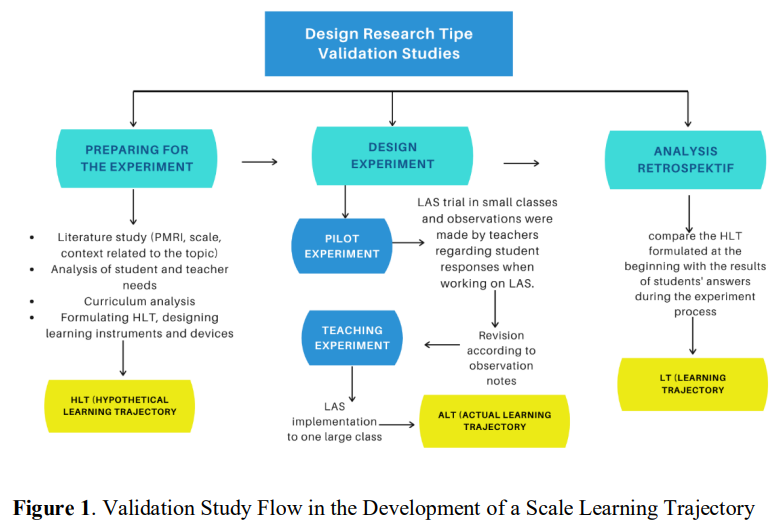
Students' difficulties in understanding the concept of scale, both conceptually and applicative, are caused by learning that is still abstract and has minimal connection to the real context, so it is necessary to present learning that is more meaningful and applicable. This study aimed to produce a learning trajectory for the concept of scale through rice field size exploration using Google Earth. The approach employed was design research of validation studies type, which encompassed three stages: design preparation, design experiment, and retrospective analysis. The study was conducted at State Junior High School 1 Belitang involving two classes, eight students from class VII.3 and thirty-one students from class VII.4. Data was collected through student activity sheets, observations, and interviews, then analyzed qualitatively using descriptive methods with triangulation techniques. The results showed that learning trajectory for the concept of scale starting from measuring images, comparing sizes in images and actual sizes, making model representations through double number lines, discussing the concept of scale and applying scale in real calculations. The study implied the importance of contextual digital media in fostering meaningful and concrete understanding of mathematical concepts.
Downloads
References
Alfatikh, E. R., Winanti, E. T., Prasetya, S. P., & Budiyanto, E. (2020). Implementing google earth to enchance student’s engagement and learning outcome in geography learning. Geosfera Indonesia, 5(1), 147–159. https://doi.org/10.19184/geosi.v5i1.11987
Arista, G. A., Wibawa, K. A., & Payadnya, I. P. A. A. (2022). Analysis of students' errors in solving comparison and scale problems based on Polya's four steps in Class VII SMP TP 45 Denpasar [in Bahasa]. PRISMA (Prosiding Seminar Nasional Matematika), 5, 214–221. https://journal.unnes.ac.id/sju/prisma/article/view/54274
Bulut, N., & Ferri, R. B. (2025). Bridging mathematical modelling and education for sustainable development in pre-service primary teacher education. Education Sciences, 15(2), 1–25. https://doi.org/10.3390/educsci15020248
Chau, T. M., & Dinh, T. T. (2023). Application of google earth software for teaching students of geography education at an Giang University, Vietnam in the direction. European Journal of Education Studies, 10(2), 193–202. https://doi.org/10.46827/ejes.v10i2.4671
Fatayan, A. (2024). Analyzing the impact of google earth on the learning motivation of elementary school. Indonesian Journal of Research and Educational Review, 3(2), 103–118. https://doi.org/10.51574/ijrer.v3i2.1418
Herlawan, Armin, R., & Poa, I. R. (2023). Effectiveness of mathematics learning through pmri approach assisted by learning videos on students' critical thinking skills [in Bahasa]. Edumatica: Jurnal Pendidikan Matematika, 13(3), 214–223. https://doi.org/10.22437/edumatica.v13i03.21918
Iqbal, M., Rahayu, S., & A, T. H. (2021). The effect of web-based learning media and educational games on comparison and scale material on student interest in learning at the junior high school level [in Bahasa]. Jurnal Ilmiah Ilmu Dan Teknologi Rekayasa, 4(1), 1–9. https://ejournal.polsub.ac.id/index.php/jiitr/article/view/89
Jaeger, A. J. (2024). Google earth as a tool for supporting geospatial thinking. Land, 13(2218), 55–60. https://www.mdpi.com/2073-445X/13/12/2218
Khoirunnisaa’, K., & Fahmi, M. R. (2023). Improving problem-solving student ability: Integrating google earth with SETS model learning for effective solutions. Abjadia : International Journal of Education, 8(1), 17–28. https://doi.org/10.18860/abj.v8i1.19699
Kinanti, T. R., Gunardi, D. P., & Rudhito, M. A. (2024). Development of contextual math learning activities (merapi mountain) using google earth [in Bahasa]. Journal Numeracy, 11(2), 155–169. https://doi.org/10.46244/numeracy.v11i2.2802
Mardhiyah, E. I., Qohar, A., & Anwar, L. (2023). Development of smart board learning media with pmri approach on whole number material [in Bahasa]. Edumatica : Jurnal Pendidikan Matematika, 13(02), 181–190. https://doi.org/10.22437/edumatica.v13i02.21617
Nos, R. L., & Motta, G. P. (2024). Using google earth to explore concepts of spherical geometry in mathematics education. International Journal of Exact Sciences, 1(3). https://doi.org/10.22533/at.ed.153132423105
Nurhayati, S., Kandaga, T., Gusti, V. Y. K., & Mohamad, L. (2025). Development of the sources of mathematics online learning self-efficacy scale (SMOLSES) for SDGs quality education. Al-Jabar: Jurnal Pendidikan Matematika, 16(01), 193–206. https://doi.org/10.24042/ajpm.v16i1.26653
Nusantara, D. S., & Putri, R. I. I. (2018). Slope of straight line in ladder: A learning trajectory. Journal of Physics: Conference Series, 1097(1). https://doi.org/10.1088/1742-6596/1097/1/012116
Nusantara, D. S., Zulkardi, & Putri, R. I. I. (2021). Designing PISA-like mathematics task using a COVID-19 context (Pisacomat). Journal on Mathematics Education, 12(2), 349–364. https://doi.org/10.22342/JME.12.2.13181.349-364
Petit, M. M., Laird, R. E., Wyneken, M. F., Huntoon, F. R., Abele-Austin, M. D., & Sequeira, J. D. (2020). A Focus on Ratios and Proportions. Routledge. https://doi.org/10.4324/9780429353611
Putri, N. N., Alvira, S., Nurjanah, I. J., Umairoh, U., & Rostika, D. (2023). Analysis of mathematics learning difficulties of elementary school students on comparison and scale materials [in Bahasa]. Didaktik: Jurnal Ilmiah PGSD FKIP Universitas Mandiri, 9(1), 104–116. https://doi.org/10.36989/didaktik.v9i5.2459
Putri, R. I. I., Zulkardi, Sari, N., Sagita, L., Siligar, E. I. P., & Sukma, Y. (2025). Learning numeracy using new Pempek mathematics. Journal on Mathematics Education, 16(1), 1–22. https://doi.org/10.22342/jme.v16i1.pp1-22
Rawani, D., Putri, R. I. I., Zulkardi, Z., & Susanti, E. (2023). The reflective teaching practices using PMRI and collaborative learning. Jurnal Pendidikan Matematika, 17(1), 69–88. https://doi.org/10.22342/jpm.17.1.17208.69-88
Ria, R. R., & Handayani, G. S. (2024). Literature study : Effectiveness of using interactive media “google earth” in social studies learning for elementary school students. International Journal of Education Elementaria and Psychologia, 1(2), 112–123. https://doi.org/10.70177/ijeep.v1i2.930
Risdiyanti, I., & Prahmana, R. C. I. (2021). Designing learning trajectory of set through the indonesian shadow puppets and mahabharata stories. Infinity Journal, 10(2), 331–348. https://doi.org/10.22460/infinity.v10i2.p331-348
Sagita, L., Putri, R. I. I., Zulkardi, & Prahmana, R. C. I. (2025). Choosing the right store: How open-ended tasks help middle school students learn financial literacy. Mathematics Education Journal, 19(1), 63–80. https://doi.org/10.22342/jpm.v19i1.pp63-80
Sakurai, J., & Goos, M. (2023). Revisiting tools in numeracy learning: The role of authentic digital tools. Frontiers in Education, 8, 1–11. https://doi.org/10.3389/feduc.2023.1291407
Saputro, H. B. (2023). Development of math modules on comparison and scale materials for grade v elementary school students [in Bahasa]. Jurnal Fundadikdas (Fundamental Pendidikan Dasar), 6(1), 37–49. https://doi.org/10.12928/fundadikdas.v6i1.7826
Sari, F. Y., Sugiman, Asikin, M., Mulyono, & Agoestanto, A. (2022). Students' mathematical creative thinking ability in the means ends analysis model assisted by open ended questions [in Bahasa]. Musamus Jurnal of Mathematics Education, 5(1), 1–10. https://doi.org/0.35724/.v5i1.4396
Sari, F. Y., Zulkardi, Putri, R. I. I., Susanti, E., & Nusantara, D. S. (2024). Ratio material learning design using the context of cooking rice to help elementary students understand concepts. Inomatika, 6(1), 54–66. https://doi.org/10.35438/inomatika.v6i1.443
Sari, F. Y., Zulkardi, Z., Putri, R. I. I., & Susanti, E. (2025a). Learning trajectory of rate material using the context of plowing rice fields. Plusminus: Jurnal Pendidikan Matematika, 5(1), 141–154. https://doi.org/10.31980/plusminus.v5i1.2509
Sari, F. Y., Zulkardi, Z., Putri, R. I. I., & Susanti, E. (2025b). Ratios in agriculture : A rice fertilization context for ratio learning trajectory. Mathematics Education Journal, 19(3), 509–526. https://doi.org/10.22342/jpm.v19i3.pp509-526
Sari, R. M., Arifin, S., & Komarudin. (2025). Development of RME worksheets with maritime context to strengthen mathematical communication skills [in Bahasa]. Edumatica: Jurnal Pendidikan Matematika, 15(01). https://doi.org/10.22437/edumatica.v15i1.41178
Sukasno, Zulkardi, Putri, R. I. I., & Somakim. (2024). Fraction learning design using the Watervang dam context [in Bahasa]. Jurnal Pendidikan Matematika RAFA, 10(1), 12–22. http://jurnal.radenfatah.ac.id/index.php/jpmrafa
Sukmaningthias, N., Sari, N., Somakim, S., Susanti, E., & Safitri, D. (2022). Student worksheets based on rme with cabri 3d to students’ mathematical connections on solid with non-flat surface. Edumatica : Jurnal Pendidikan Matematika, 12(03), 222–237. https://doi.org/10.22437/edumatica.v12i03.21364
Trisnawati, T., Yulianto, D., & Ningsih, E. F. (2023). The influence of Indonesian realistic mathematics learning (PMRI) basedethnomathematicson the improvement of mathematical communication skills in terms of gender. Scholar: Educational Scientific Journal Media, 13(3), 552–561. https://doi.org/10.35335/cendikia.v13i3.3320
Utami, M. R. P., Zulkardi, Susanti, E., & Meryansumayeka. (2024). Learning design of two-variable linear equation system material with the context of jakabaring palembang tourism [in Bahasa]. Edumatica: Jurnal Pendidikan Matematika, 14(03), 242–258. https://doi.org/10.22437/edumatica.v14i3.38806
Utari, R. S., Ilma, R., & Putri, I. (2024). Designing learning trajectories to support prospective teachers ’ statistical literacy skills. Mosharafa : Jurnal Pendidikan Matematika, 13(4), 877–894. https://doi.org/10.31980/mosharafa.v13i4.2546
Wahid, A. (2023). Improving conceptual understanding of mathematics through blended learning using Google Classroom. International Journal of Education and Teaching Zone, 2(1), 130–138. https://doi.org/10.57092/ijetz.v2i1.122
Widiastuti, B., & Nindiasari, H. (2022). Application of realistic mathematics learning to develop mathematical problem solving skills of elementary school students [in Bahasa]. Jurnal Cendekia : Jurnal Pendidikan Matematika, 6(3), 2526–2535. https://doi.org/10.31004/cendekia.v6i3.1190
Wijayanti, R., Kurniawan, S. B., & Budiharto, T. (2022). Analysis of mathematics learning of scale and comparison materials in grade V elementary school [in Bahasa]. Jurnal Pendidikan Dasar, 10(1). https://doi.org/10.20961/jpd.v11i1.64475
Zakaria, Z., & Dewantara, A. H. (2024). Understanding multiplication concept: Exploring PMRI-enhanced thematic learning using traditional games for primary teachers. Jurnal Elemen, 10(1), 55–69. https://doi.org/10.29408/jel.v10i1.19838
Downloads
Published
How to Cite
Issue
Section
License
Copyright (c) 2025 Filian Yunita Sari, Zulkardi Zulkardi, Ratu Ilma Indra Putri, Ely Susanti

This work is licensed under a Creative Commons Attribution-NonCommercial-ShareAlike 4.0 International License.