
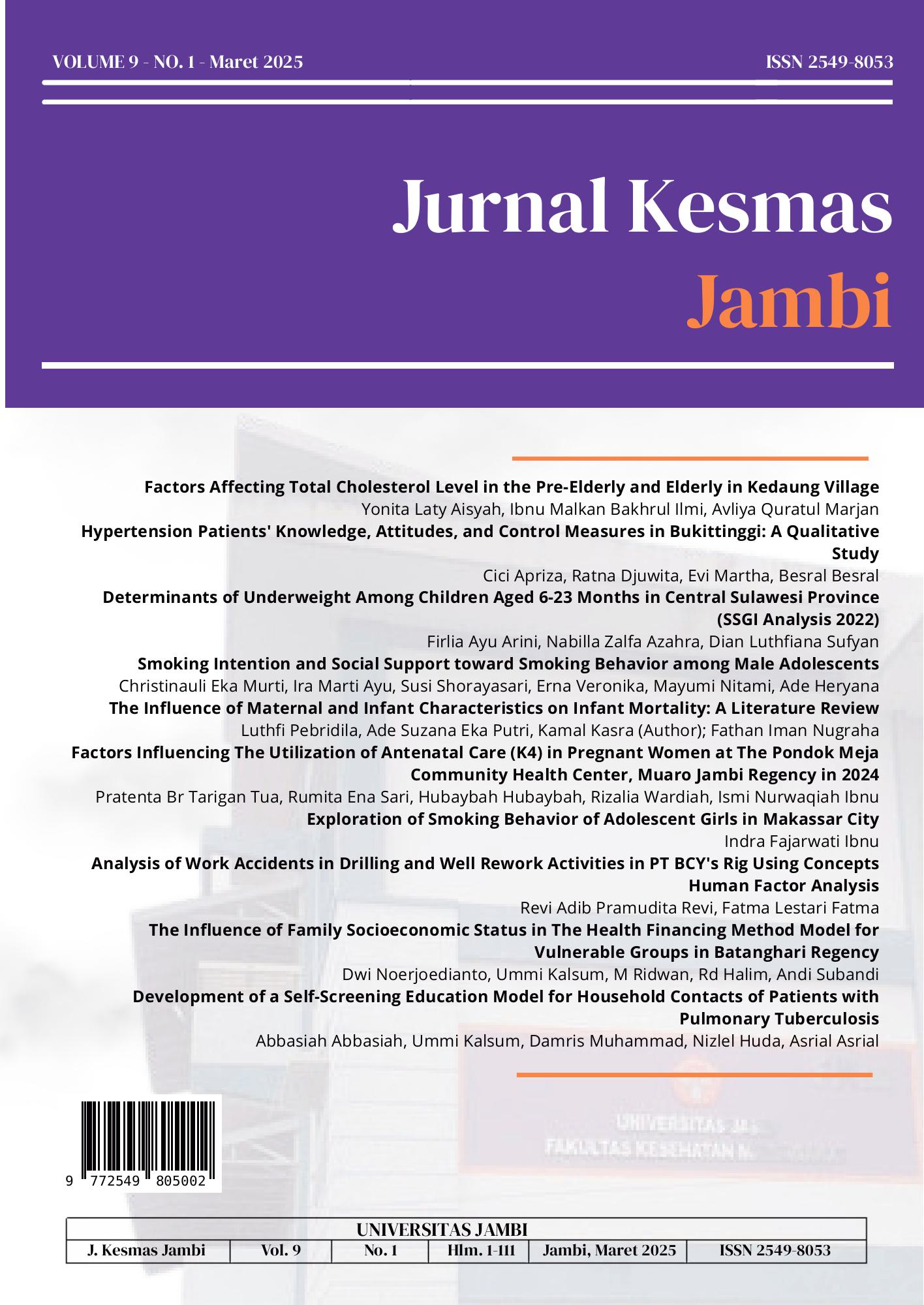
Smoking Intention and Social Support toward Smoking Behavior among Male Adolescents
DOI:
https://doi.org/10.22437/jkmj.v9i1.42128Keywords:
Accessibility Information, Intention to Smoke, Smoking Behavior, Social SupportAbstract
The prevalence of smoking among children and adolescents in Indonesia has been reported to have significantly increased, with more male adolescents smoking than female adolescents. A preliminary study conducted at SMAN X, Tangerang Regency, found that 7 out of 20 male students (35%) reported smoking. The high prevalence of smoking among adolescent males could lead to more serious health issues in the future. This study aims to identify the factors associated with smoking behaviour among male adolescents at SMAN X Tangerang Regency in 2024. The study used a cross-sectional study with 72 sample sizes of male adolescents. The sampling technique used in this study was total sampling. The researcher collected data from April to August 2024. Primary data was collected through a questionnaire. Data were analyzed using univariate and bivariate analysis with chi-square tests. Univariate results show the highest proportions: non-smoking behaviour (69.4%), low intention to smoke (83.3%), unsupportive social environment (56.9%), and exposure to health information (61.1%). Bivariate results reveal a relationship between intention to smoke (PR=2.86, 95%CI=1.56 to 5.25) and social support (PR=4.50, 95%CI=1.86 to 10.86) with smoking behaviour. The school should continue its efforts to prohibit smoking among students by posting posters about the dangers of smoking and signs prohibiting smoking, as well as implementing a program involving the role of guardians/parents to actively monitor and educate adolescent males about the dangers of smoking so that they do not smoke.
Downloads
References
Tobacco Atlas. Youth Tobacco Use - Teenage Smoking Statistic [Internet]. 2023. Available from: https://tobaccoatlas.org/challenges/youth/
2. Kementerian Kesehatan RI. HTTS 2019: Jangan Biarkan Rokok Merenggut Napas Kita [Internet]. 2019. Available from: https://p2ptm.kemkes.go.id/kegiatan-p2ptm/pusat-/htts-2019-jangan-biarkan-rokok-merenggut-napas-kita
3. World Health Organization. Adolescent Health and Development [Internet]. 2020. Available from: https://www.who.int/news-room/questions-and-answers/item/adolescent-health-and-development
4. Wise RA, Robble MA. Dopamine and addiction. Annu Rev Psychol. 2020;71(1):79–106.
5. Kementerian Kesehatan RI. Bahaya dan Efek Pajanan Rokok pada Anak dan Remaja [Internet]. 2022. Available from: https://p2ptm.kemkes.go.id/infographic-p2ptm/penyakit-akibat-tembakau/bahaya-dan-efek-pajanan-rokok-pada-anak-dan-remaja
6. Wati SH, Bahtiar, Anggraini D. Dampak Merokok Terhadap Kehidupan Sosial Remaja (Studi di Desa Mabodo Kecamatan Kontunaga Kabupaten Muna). Neo Societal [Internet]. 2018;3(2):503–9. Available from: https://ojs.uho.ac.id/index.php/NeoSocietal/article/view/4054/3143
7. Hock LK, Li LH, Ghazali SM, Ling CY, Cheong KC, Pei HP, et al. Influences of parents and peers on adolescent smoking initiation: findings from a longitudinal study in Kota Tinggi District, Johor, Malaysia. Malaysian Journal of Public Health Medicine. 2021;21(2):14–21.
8. Nursal DGA, Mutia, Sari AP, Safitri VK, Wakum AY. Membongkar Dinamika Perilaku Merokok Pada Remaja. Indramayu: Penerbit Adab; 2023.
9. Faana VHM. Faktor yang Memengaruhi Perilaku Merokok Pada Remaja di SMA Negeri 20 Medan. Institut Kesehatan Helvetia; 2023.
10. Wakum AY. Faktor-Faktor Yang Berhubungan Dengan Perilaku Merokok Pada Siswa di SMPN 12 Padang Tahun 2020. Universitas Andalas; 2021.
11. Almaidah F, Khairunnisa S, Sari IP, Chrisna CD, Firdaus A, Kamiliya ZH, et al. Survei Faktor Penyebab Perokok Remaja Mempertahankan Perilaku Merokok. Jurnal Farmasi Komunitas. 2021;8(1):20–6.
12. Annisa, Haeruddin, Nurbaety. Perilaku Merokok Pada Remaja Laki-laki Kelurahan Pampang Kecamatan Panakkukang Kota Makassar. Window of Public Health Journal. 2021;2(4):716–26.
13. Mirnawati, Nurfitriani, Zulfiarini FM, Cahyati WH. Perilaku Merokok pada Remaja Umur 13-14 Tahun. Hiegia Journal of Public Health Research and Development. 2018;2(3):396–405.
14. Violita F, Mamoribo SN, Imakulada C. Faktor Pendorong Perilaku Merokok Remaja di Kabupaten Keerom, Jayapura. Molucca Medica. 2023;16(2):161–8.
15. Riyadi S. Pengaruh Paparan Media, Sikap, dan Niat Terhadap Perilaku Tidak Merokok Remaja di Yogyakarta. Media Ilmu Kesehatan. 2020;9.
16. Yulianto B. Perilaku Penggunaan APD Sebagai Alternatif Meningkatkan Kinerja Karyawan yang Terpapar Bising Intensitas Tinggi. Surabaya: Scopindo Media Pustaka; 2020.
17. Batu AM, Jaya IMM, Mahendra D. Buku Ajar Promosi Kesehatan. Jakarta: Universitas Kristen Indonesia; 2019.
18. Sankır Ş, Sankır H, Kardeş VÇ, Atasoy N. A Qualitative Study: An Evaluation of Smoking Among Young People Aged 15--20 Years in Turkey Using Bourdieu’s Concepts. Addicta: The Turkish Journal on Addictions. 2022;9(3):233–40.
19. Achmad PWA, Irwandi I, Saputro KA. Kajian Semiotika Terhadap Maskulinitas Dalam Foto Iklan Rokok Gudang Garam Djaja Edisi ‘Rahasia Djaja’tahun 2015. specta. 2017;1(2):149–62.
20. Fadhila F, Widati S, Fatah M. Pengaruh Iklan Rokok Terhadap Perilaku Merokok Remaja di Daerah Kota dan Desa Kabupaten Pamekasan. Medical Technology and Public Health Journal. 2021;5(2):198–208.
21. Nurhalimah N, Putri FY, Haryati O, Dinarti D. Pengaruh Iklan Rokok Terhadap Perilaku Merokok Remaja. Journal of Health and Cardiovascular Nursing. 2024;4(1):34–41.
22. Hamzah PK, Faisal DR, Kasra K, Ilmaskal R, Iqbal W, Yusda I, et al. Differences in Adolescents’ Smoking Behavior and Media Exposure to Smoking Advertisements in Urban and Rural Padang City. The Indonesian Journal of Health Promotion and Health Education. 2024;12(2):134–42.
23. Vente T, Daley M, Killmeyer E, Grubb LK. Association of social media use and high-risk behaviors in adolescents: cross-sectional study. JMIR Pediatr Parent. 2020;3(1):e18043.
24. Anjani DM, Prasetyoaji A. Tingkat intensitas penggunaan media sosial di kalangan remaja. In: Seminar Nasional Bimbingan dan Konseling Universitas Ahmad Dahlan. 2023. p. 1144–58.
25. Vogel EA, Ramo DE, Rubinstein ML, Delucchi KL, Darrow SM, Costello C, et al. Effects of social media on adolescents’ willingness and intention to use e-cigarettes: an experimental investigation. Nicotine and Tobacco Research. 2021;23(4):694–701.
26. Chinwong D, Mookmanee N, Chongpornchai J, Chinwong S. A comparison of gender differences in smoking behaviors, intention to quit, and nicotine dependence among Thai university students. J Addict. 2018;2018(1):8081670.
27. Rahman KMM, Tareque MI. Determinants of cigarette/bidi smoking among youth male in rural Mymensingh of Bangladesh: A cross-sectional study. PLoS One. 2020;15(12):e0244335.
28. Humaira NAS, Utami R, Prabowo YD. Studi Kasus Remaja Laki-Laki Yang Merokok Di Sekolah Menengah Pertama. EDU RESEARCH. 2024;5(3):126–35.
29. Alsubaie ASR. Prevalence and determinants of smoking behavior among male school adolescents in Saudi Arabia. Int J Adolesc Med Health. 2020;32(4):20170180.
30. Agustin RN, Sulaeman ES, Prasetya H. Contextual effect of school and other determinants of non smoking behavior among High School Students in Bantul, Yogyakarta: a multilevel analysis. Journal of Health Promotion and Behavior. 2019;4(4):274–86.
31. Oqui M, Wulandari NA, do Rosà A. Knowledge about The Dangers of Smoking and Smoking Behavior of Students in Septembro Unamet 4th High school Dili, Timor Leste. Jurnal Ners dan Kebidanan (Journal of Ners and Midwifery). 2022;9(2):162–7.
32. Nurhasanah T, Kurnia SI. The Relationship Between Knowledge about the Dangers of Cigarettes and Smoking Behavior in Junior High School Students. Jurnal Keperawatan. 2023;15(4):413–22.
33. Martias I, Nursamsi S. Pengaruh Penyuluhan Mengenai Bahaya Merokok Menggunakan Media Leaflet Terhadap Perubahan Pengetahuan Dan Sikap Siswa Di SMPN 3 Bintan Timur. Jurnal Kesmas Jambi. 2017;1(2):76–81.
Downloads
Published
Issue
Section
License
Copyright (c) 2025 Ira Marti Ayu, Christinauli Eka Murti, Susi Shorayasari, Erna Veronika, Mayumi Nitami, Ade Heryana (Author)

This work is licensed under a Creative Commons Attribution 4.0 International License.
Proposed Creative Commons Copyright Notices
1. Proposed Policy for Journals That Offer Open Access
Authors who publish with this journal agree to the following terms:
- Authors retain copyright and grant the journal right of first publication with the work simultaneously licensed under a Creative Commons Attribution License that allows others to share the work with an acknowledgement of the work's authorship and initial publication in this journal.
- Authors are able to enter into separate, additional contractual arrangements for the non-exclusive distribution of the journal's published version of the work (e.g., post it to an institutional repository or publish it in a book), with an acknowledgement of its initial publication in this journal.
- Authors are permitted and encouraged to post their work online (e.g., in institutional repositories or on their website) prior to and during the submission process, as it can lead to productive exchanges, as well as earlier and greater citation of published work (See The Effect of Open Access).
Proposed Policy for Journals That Offer Delayed Open Access
Authors who publish with this journal agree to the following terms:
- Authors retain copyright and grant the journal right of first publication, with the work [SPECIFY PERIOD OF TIME] after publication simultaneously licensed under a Creative Commons Attribution License that allows others to share the work with an acknowledgement of the work's authorship and initial publication in this journal.
- Authors are able to enter into separate, additional contractual arrangements for the non-exclusive distribution of the journal's published version of the work (e.g., post it to an institutional repository or publish it in a book), with an acknowledgement of its initial publication in this journal.
- Authors are permitted and encouraged to post their work online (e.g., in institutional repositories or on their website) prior to and during the submission process, as it can lead to productive exchanges, as well as earlier and greater citation of published work (See The Effect of Open Access).


 p-ISSN :
  e-ISSN :


