
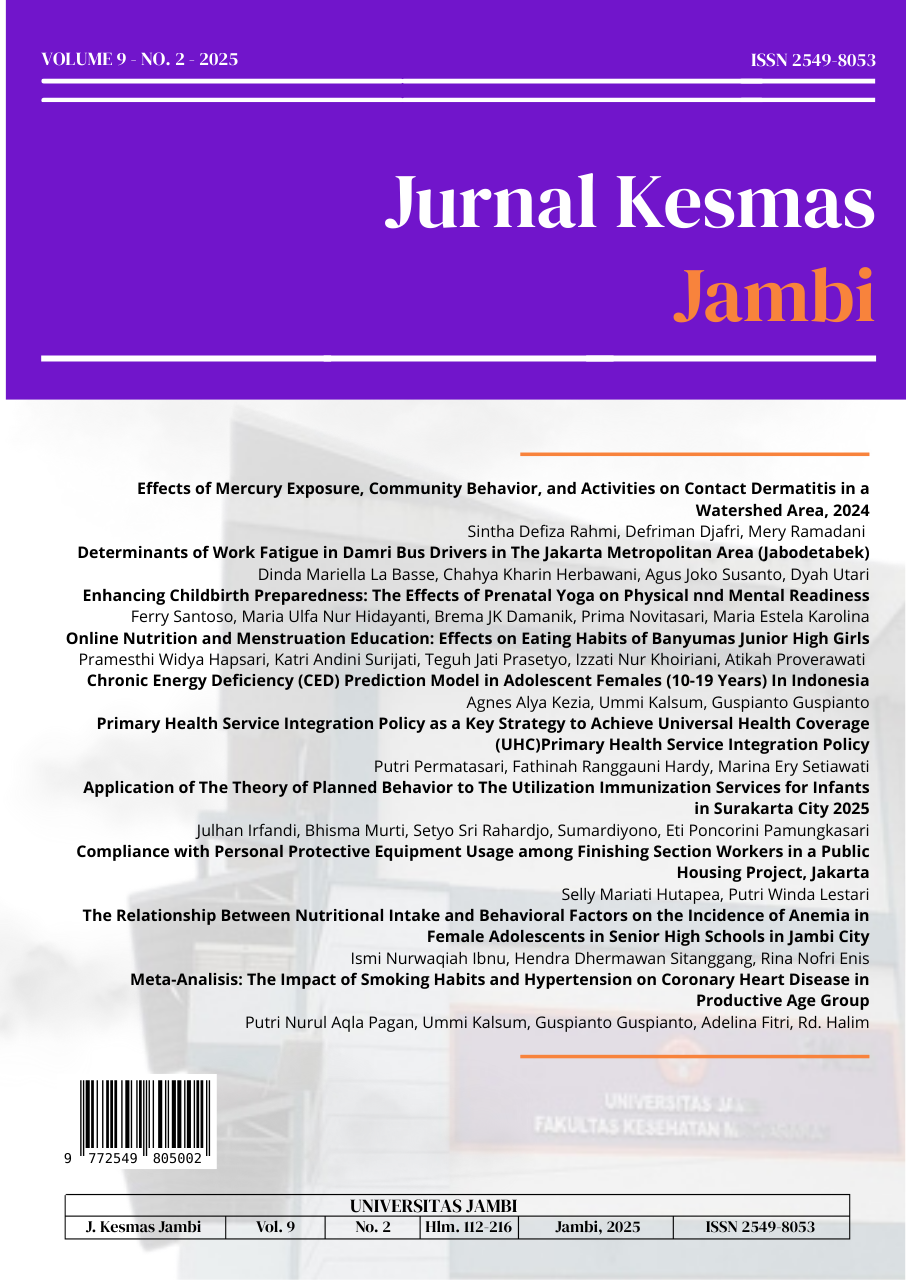
The Relationship Between Nutritional Intake and Behavioral Factors on the Incidence of Anemia in Female Adolescents in Senior High Schools in Jambi City
DOI:
https://doi.org/10.22437/jkmj.v9i2.48431Keywords:
Anemia, Adolescents, Protein intake, knowledge, attitudeAbstract
Adolescents are one of the high-risk groups for anemia. Adolescent girls who experience anemia and chronic energy deficiency are at risk of becoming stunted mothers. This study aims to identify the prevalence and determinants of adolescent girls that increase the risk of anemia in Jambi City. This study is an analytical study using a cross-sectional research design. The study was conducted from July to November 2024. The population in this study were all female high school students in Jambi City in 2023, namely 6878 students. The minimum sample in this study was 201 female adolescents, who were divided into 6 public secondary schools that were randomized in clusters, grade XI female students, did not experience chronic/acute diseases related to bleeding. The variable of hemoglobin levels was measured by direct examination, the consumption variable was interviewed using a semi-FFQ questionnaire. Knowledge and attitude variables about anemia were also collected using a validated questionnaire. Univariate and bivariate tests and to measure the magnitude of risk using the SPSS data analysis program application. The results of this study are the prevalence of anemia in adolescent girls, namely 131 adolescents (64.7%) and the prevalence of chronic energy deficiency of 89 adolescents (44.3%). The conclusion is that the factors that influence the incidence of anemia in adolescent girls in Jambi City are carbohydrate intake (p.value = 0.033), protein intake (p-value = 0.000), iron intake (p.value = 0.000), zinc intake (p.value = 0.021), knowledge about anemia (p.value = 0.000), and attitudes towards anemia. (p.value = 0.000).
Downloads
References
1. Larsen B, Luna B. Adolescence as a neurobiological critical period for the development of higher-order cognition. Neurosci Biobehav Rev. 2018 Nov 1;94:179–95.
2. Sawyer SM, Azzopardi PS, Wickremarathne D, Patton GC. The age of adolescence. Lancet Child Adolesc Health. 2018 Mar 1;2(3):223–8.
3. Jaworska N, MacQueen G. Adolescence as a unique developmental period. J Psychiatry Neurosci. 2015 Sep 1;40(5):291–3.
4. Kementerian Kesehatan Republik Indonesia. Profil Kesehatan Indonesia Tahun 2023. Jakarta; 2024.
5. WHO. Global nutrition targets 2025: anaemia policy brief [Internet]. 2014 [cited 2025 Sep 10]. Available from: https://www.who.int/publications/i/item/WHO-NMH-NHD-14.4
6. Anemia pada wanita dan anak-anak [Internet]. [cited 2025 Dec 1]. Available from: https://www.who.int/data/gho/data/themes/topics/anaemia_in_women_and_children
7. Rah JH, Melse-Boonstra A, Agustina R, van Zutphen KG, Kraemer K. The Triple Burden of Malnutrition Among Adolescents in Indonesia. Food Nutr Bull [Internet]. 2021 Jun 1 [cited 2025 Sep 10];42(1_suppl):S4–8. Available from: https://scholar.ui.ac.id/en/publications/the-triple-burden-of-malnutrition-among-adolescents-in-indonesia
8. Norris SA, Frongillo EA, Black MM, Dong Y, Fall C, Lampl M, et al. Nutrition in adolescent growth and development. Lancet. 2022 Jan 8;399(10320):172–84.
9. Badan Kebijakan Pembangunan Kesehatan. SKI 2023 DALAM ANGKA. 2024.
10. UNICEF. Social and Behaviour Change Communication Strategy: Improving Adolescent Nutrition in Indonesia. 2021.
11. WHO. SDG Target 2.2 Malnutrition [Internet]. 2025 [cited 2025 Sep 10]. Available from: https://www.who.int/data/gho/data/themes/topics/sdg-target-2_2-malnutrition
12. Christides T, Sharp P. Sugars Increase Non-Heme Iron Bioavailability in Human Epithelial Intestinal and Liver Cells. PLoS One [Internet]. 2013 [cited 2025 Sep 17];8(12):83031. Available from: www.plosone.org
13. Milman NT. A Review of Nutrients and Compounds, Which Promote or Inhibit Intestinal Iron Absorption: Making a Platform for Dietary Measures That Can Reduce Iron Uptake in Patients with Genetic Haemochromatosis. 2020 [cited 2025 Sep 17]; Available from: https://doi.org/10.1155/2020/7373498
14. Morris AL, Mohiuddin SS. Biochemistry, Nutrients. StatPearls [Internet]. 2023 May 1 [cited 2025 Sep 17]; Available from: http://europepmc.org/books/NBK554545
15. Hooda J, Shah A, Zhang L. Heme, an Essential Nutrient from Dietary Proteins, Critically Impacts Diverse Physiological and Pathological Processes. Nutrients [Internet]. 2014 [cited 2025 Sep 17];6:1080–102. Available from: www.mdpi.com/journal/nutrients
16. Wessling-Resnick M. Iron: Basic Nutritional Aspects. Molecular, Genetic, and Nutritional Aspects of Major and Trace Minerals [Internet]. 2017 Jan 1 [cited 2025 Sep 17];161–73. Available from: https://www.sciencedirect.com/science/article/abs/pii/B9780128021682000142
17. Kumar A, Sharma E, Marley A, Samaan MA, Brookes MJ. Iron deficiency anaemia: Pathophysiology, assessment, practical management. Vol. 9, BMJ Open Gastroenterology. BMJ Publishing Group; 2022.
18. Wang C, Wang X, Song G, Xing H, Yang L, Han K, et al. A high-fructose diet in rats induces systemic iron deficiency and hepatic iron overload by an inflammation mechanism. J Food Biochem [Internet]. 2021 Jan 1 [cited 2025 Sep 17];45(1):e13578. Available from: /doi/pdf/10.1111/jfbc.13578
19. Indriasari R, Mansur MA, Srifitayani NR, Tasya A. Pengetahuan, Sikap, dan Tindakan terkait Pencegahan Anemia pada Remaja Sosial-Ekonomi Menengah ke Bawah di Makassar.
20. Agustina R, Wirawan F, Sadariskar AA, Setianingsing AA, Nadiya K, Prafiantini E, et al. Associations of Knowledge, Attitude, and Practices toward Anemia with Anemia Prevalence and Height-for-Age Z-Score among Indonesian Adolescent Girls. Food Nutr Bull [Internet]. 2021 Jun 1 [cited 2025 Sep 17];42(1_suppl):S92–108. Available from: https://scholar.google.com/scholar_url?url=https://journals.sagepub.com/doi/pdf/10.1177/03795721211011136&hl=id&sa=T&oi=ucasa&ct=ufr&ei=XnrKaP2MLfmI6rQPkqGmqQg&scisig=AAZF9b-XgZaHqdSVo8kcxNSFV57G
21. Indriasari R, Fitayani NS, Mansur MA, Tunru A. Alarming nutrition problems among adolescent students attending islamic boarding school in Indonesia. Enferm Clin [Internet]. 2020 Jun 1 [cited 2025 Sep 17];30:44–7. Available from: https://www.sciencedirect.com/science/article/abs/pii/S1130862120301340
22. Izdihar MS, Noor MS, Istiana I, Juhairina J, Skripsiana NS. Hubungan Pengetahuan dan Sikap tentang Anemia dengan Perilaku Pencegahan Anemia pada Remaja Puteri di SMAIT Ukhuwah Banjarmasin. Homeostasis [Internet]. 2022 Aug 31 [cited 2025 Sep 17];5(2):333–42. Available from: https://ppjp.ulm.ac.id/journals/index.php/hms/article/view/6278
23. Indriasari R, Mansur MA, Rachmat M. Comprehensive knowledge and supports from closest relatives are crucial to improve awareness and participation of Indonesian adolescent girls in anemia prevention program. Int J Adolesc Med Health [Internet]. 2024 Oct 1 [cited 2025 Sep 17];36(5):513–21. Available from: https://www.degruyterbrill.com/document/doi/10.1515/ijamh-2024-0064/html
Downloads
Published
Issue
Section
License
Copyright (c) 2025 Ismi Nurwaqiah Ibnu, Hendra Dhermawan Sitanggang, Rina Nofri Enis (Author)

This work is licensed under a Creative Commons Attribution 4.0 International License.
Proposed Creative Commons Copyright Notices
1. Proposed Policy for Journals That Offer Open Access
Authors who publish with this journal agree to the following terms:
- Authors retain copyright and grant the journal right of first publication with the work simultaneously licensed under a Creative Commons Attribution License that allows others to share the work with an acknowledgement of the work's authorship and initial publication in this journal.
- Authors are able to enter into separate, additional contractual arrangements for the non-exclusive distribution of the journal's published version of the work (e.g., post it to an institutional repository or publish it in a book), with an acknowledgement of its initial publication in this journal.
- Authors are permitted and encouraged to post their work online (e.g., in institutional repositories or on their website) prior to and during the submission process, as it can lead to productive exchanges, as well as earlier and greater citation of published work (See The Effect of Open Access).
Proposed Policy for Journals That Offer Delayed Open Access
Authors who publish with this journal agree to the following terms:
- Authors retain copyright and grant the journal right of first publication, with the work [SPECIFY PERIOD OF TIME] after publication simultaneously licensed under a Creative Commons Attribution License that allows others to share the work with an acknowledgement of the work's authorship and initial publication in this journal.
- Authors are able to enter into separate, additional contractual arrangements for the non-exclusive distribution of the journal's published version of the work (e.g., post it to an institutional repository or publish it in a book), with an acknowledgement of its initial publication in this journal.
- Authors are permitted and encouraged to post their work online (e.g., in institutional repositories or on their website) prior to and during the submission process, as it can lead to productive exchanges, as well as earlier and greater citation of published work (See The Effect of Open Access).

 p-ISSN :
  e-ISSN :


