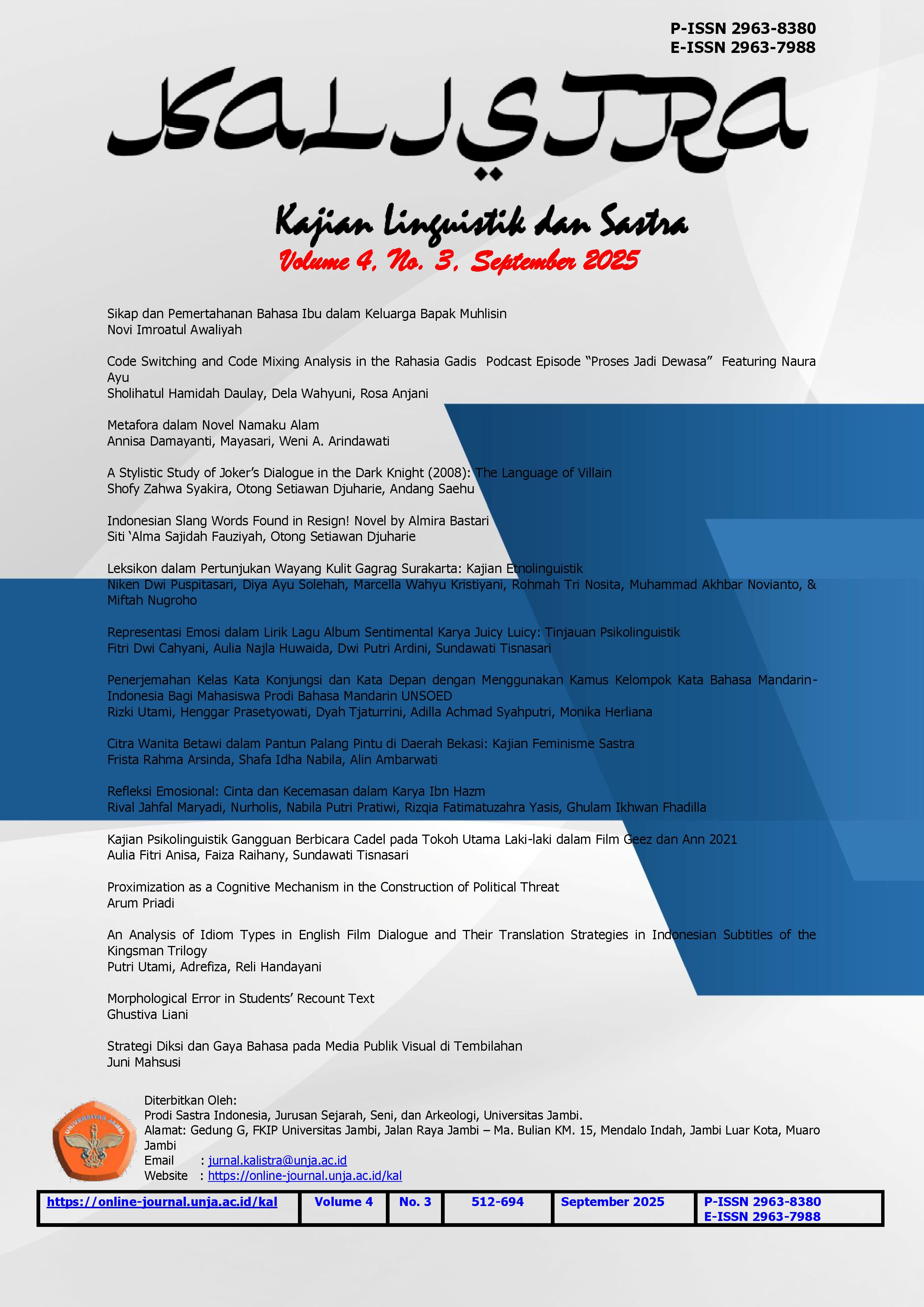
Sikap dan Pemertahanan Bahasa Ibu dalam Keluarga Bapak Muhlisin
DOI:
https://doi.org/10.22437/kalistra.v4i3.46889Keywords:
sikap bahasa, pemertahanan, bahasa ibu, sosiolinguistikAbstract
Language attitudes and language maintenance can be studied through a sociolinguistic approach based on individual speakers. Language attitudes are divided into two categories: positive and negative. A positive attitude is reflected in efforts to maintain a language by preserving it and feeling proud to use it. This can be observed in the family of Mr. Muhlisin, who have two different mother tongues. However, each member of the family strives to maintain their own mother tongue. Therefore, the data source used in this article is the utterances between two speakers within the family, collected through the observation method. The result of this study shows that Mr. Muhlisin's family demonstrates a positive language attitude and maintains their language in daily communication.
Abstrak
Sikap dan pemertahanan bahasa dapat dikaji melalui studi sosiolinguistik berdasarkan individu penutur bahasa. Sikap bahasa terbagi menjadi dua, sikap positif dan negatif. Sikap positif merupakan sikap mempertahankan bahasa dengan menjaga bahasa dan merasa bangga menggunakannya. Hal tersebut dapat ditemui dalam keluarga bapak Muhlisin yang memiliki dua bahasa ibu. Akan tetapi, dalam keluarga tersebut saling mempertahankan bahasa ibu masing-masing. Sehingga sumber data yang digunakan dalam artikel ini adalah tuturan antara dua penutur dalam keluarga tersebut dengan metode observasi. Hasil dari penelitian ini adalah keluarga bapak Muhlisin tergolong memiliki sikap positif dan mempertahankan bahasa dalam komunikasi.
Downloads
References
Ayu Purnamasari, & Wira Jaya Hartono. (2023). Pentingnya Penggunaan Bahasa Indonesia Di Perguruan Tinggi. Jotika Journal in Education, 2(2), 57.
Bulan, D. R. (2019). Bahasa Indonesia Sebagai Identitas Nasional Bangsa Indonesia. Jisipol, 3(2), hlm.23-29.
Diah Purwianti, Dessy Wardiah, & Muhammad Ali. (2025). Sikap Bahasa Peserta Didik Smp Negeri 1 Belitang Jaya Terhadap Bahasa Indonesia (Kajian Sosiolinguistik). Jurnal Pembahsi (Pembelajaran Bahasa Dan Sastra Indonesia), 15(2), 157–168. https://doi.org/10.31851/pembahsi.v15i2.18067
Fadli, M. R. (2021). Memahami desain metode penelitian kualitatif. Humanika, 21(1), 33–54. https://doi.org/10.21831/hum.v21i1.
Fitriyah, & Turistiani, T. D. (2022). Mengukur Sikap Mahasiswa Universitas Tridinanti Palembang Terhadap Bahasa Indonesia. Jurnal Bindo Sastra, 6(1), 27. https://doi.org/10.32502/jbs.v6i1.4052
Gurning, R. A., Sipayung, W. W., Sinurat, E., & Saragih, Y. S. (2024). Analisis Sosiolinguistik : Perspektif Bahasa Dalam Masyarakat. 4.
Houbner, T. (1996). Sociolinguistic Prespectives: Paper on Language in Society 1956-1994 Charles A. Ferguson. Oxford: Oxford University Press.
Mailani, O., Nuraeni, I., Syakila, S. A., & Lazuardi, J. (2022). Bahasa Sebagai Alat Komunikasi Dalam Kehidupan Manusia. Kampret Journal, 1(1), 1–10. https://doi.org/10.35335/kampret.v1i1.8
Mesthrie, R. (2001). Concise Encyclopedia of Sociolinguistics. Amsterdam-New York: Elsievir.
Mesthrie, R. (2009). Introducting Sociolinguistics. Edinburgh: Edinburgh University Press.
Meyerhoff, M. (2006). Introducting Sociolinguistics. London and New York: Routledge.
Pratiwi, L., Khairani, N., & Khairan, R. (2023). Argopuro: Jurnal Multidisiplin Ilmu Bahasa. Argopuro: Jurnal Multidisiplin Ilmu Bahasa, 1(4), 1–14. https://ejournal.warunayama.org/index.php/argopuro/article/view/1107
Ramdhani, I. S., & Enawar, E. (2019). admin_lptik,+30-Artikel+Intan+Sari+Ramdhani+&+Enawar. Jurnal Seminar Nasional Bulan Bahasa, 277–283.
Schilling, N. (2013). Sociolinguistic Fieldwork. New York: Cambridge University Press.
Weinzierl, M. L. (2024). Bridging the Boundaries of Corporate Language Competence in Multinational Teams. Business and Professional Communication Quarterly. https://doi.org/10.1177/23294906231221135
Downloads
Published
How to Cite
Issue
Section
License
Copyright (c) 2025 Novi Imroatul Awaliyah

This work is licensed under a Creative Commons Attribution-ShareAlike 4.0 International License.
Kalistra: Kajian Linguistik dan Sastra is licensed under Creative Commons Attribution-ShareAlike 4.0 International License.

Authors who publish their manuscripts in Kajian Linguistik dan Sastra agree to the following terms:
1. The copyright in each article belongs to the author.
2. The author acknowledges that Kajian Linguistik dan Sastra reserves the right to be the first to publish under a Creative Commons Attribution-ShareAlike 4.0 International License (Attribution 4.0 International CC BY-SA 4.0).
3. Authors may submit articles separately, arranging for non-exclusive distribution of manuscripts that have been published in this journal to other versions (e.g., delivery to the author's institutional repository, publication into a book, etc.), acknowledging that the manuscript has been first published in Kajian Linguistik dan Sastra.