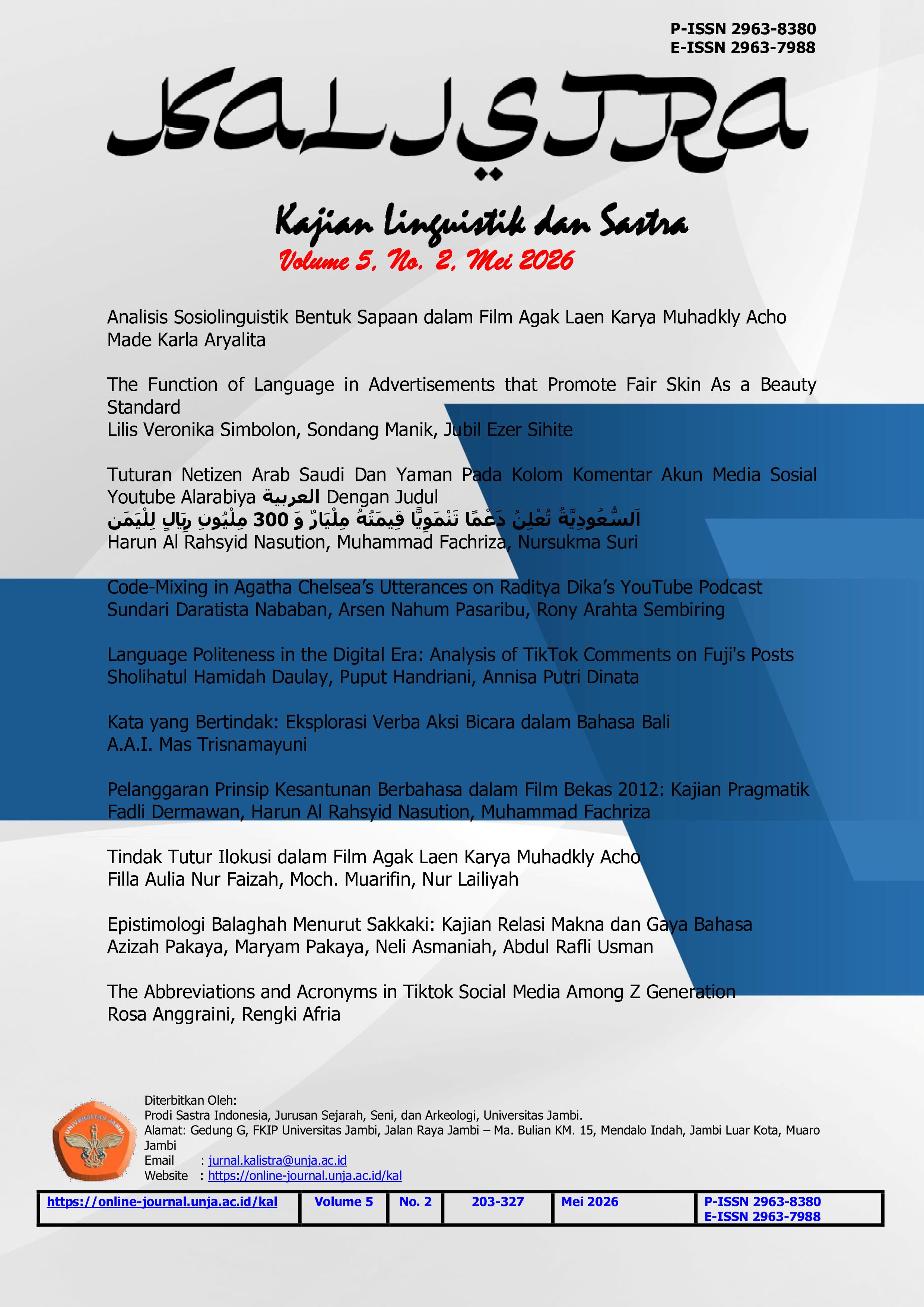
Language Politeness in the Digital Era: Analysis of TikTok Comments on Fuji's Posts
DOI:
https://doi.org/10.22437/kalistra.v5i2.52074Keywords:
language politeness, social media, TikTok, user comments, FujiAbstract
This research focuses on analyzing the politeness strategies employed by internet users in their comments on celebrity Fuji’s TikTok posts. The freedom of expression on social media fosters a variety of verbal interactions, ranging from courteous to discourteous. Utilizing a qualitative approach with pragmatic discourse analysis based on Brown and Levinson’s politeness theory, data were collected from ten screenshots of TikTok comments and analyzed in depth. The findings reveal that users implement several politeness strategies: positive politeness, negative politeness, off record, and bald on record. The bald on record strategy predominates, indicating a tendency among social media users to express opinions directly and sometimes harshly. This trend signifies a shift in traditional norms of politeness within digital communication. The study highlights the necessity of digital literacy to maintain ethical language use and foster social harmony in online environments.
Abstrak
Penelitian ini berfokus pada analisis strategi kesantunan yang digunakan oleh pengguna internet dalam komentar mereka pada unggahan TikTok selebriti Fuji. Kebebasan berekspresi di media sosial memicu berbagai interaksi verbal, mulai dari yang santun hingga yang tidak santun. Dengan menggunakan pendekatan kualitatif dengan analisis wacana pragmatik berdasarkan teori kesantunan Brown dan Levinson, data dikumpulkan dari sepuluh tangkapan layar komentar TikTok dan dianalisis secara mendalam. Temuan menunjukkan bahwa pengguna menerapkan beberapa strategi kesantunan: kesantunan positif, kesantunan negatif, off record (tidak langsung), dan bald on record (tanpa basa-basi). Strategi bald on record mendominasi, yang menunjukkan kecenderungan pengguna media sosial untuk mengekspresikan pendapat secara langsung dan terkadang kasar. Tren ini menandakan adanya pergeseran norma kesantunan tradisional dalam komunikasi digital. Studi ini menekankan pentingnya literasi digital untuk menjaga penggunaan bahasa yang etis dan memupuk harmoni sosial di lingkungan daring.
Downloads
References
Archer, D., Aijmer, K., & Wichmann, A. (2017). Pragmatics: An Advanced Resource Book for Students. Routledge.
Aziz, Z.M. (2024). Linguistic Politeness in YouTube Content by CXO Media: The Edition on Seizing Opportunities to Build Success. Jurnal Indonesia Sosial Sains.
Brown, P., & Levinson, S. C. (1987). Politeness: Some Universals in Language Usage. Cambridge University Press.
Chung, E., & Tang, E. (2022). Understanding Politeness in an Online Community of Practice for Chinese ESL Teachers: Implications for Sustainable Professional Development in the Digital Era. Sustainability.
Daulay, S. H., Saragih, A. S., & Bidadari, L. (2025). Linguistic Strategies in the Dissemination of Hoaxes on TikTok: The Role of Hashtags in Shaping Public Misconceptions. JALC: Journal of Applied Linguistic and Studies of Cultural, 3(2), 9-19.
Daulay, S. H., & Aulia, D. N. (2024). Understanding the Role of Language on Twitter: From Hashtag to Discourses. EBONY: Journal of English Language Teaching, Linguistics, and Literature, 4(2), 148–156. https://doi.org/10.37304/ebony.v4i2.12693
Daulay, S. H., & Lubis, R. A. (2024). Tweeting Between the Lines: Exploring Code Mixing In The Twittersphere. Jurnal JOEPALLT (Journal of English Pedagogy, Linguistics, Literature, and Teaching), 12(2), 226-236.
Daulay, S. H., Bahar, T., Putri, A., & Batubara, P. F. (2023). Various wordings of propaganda on social media: Cases from Instagram application. Journal of Linguistics, Literacy, and Pedagogy, 2(2), 100-107.
Daulay, S. H., Nst, A. H., Ningsih, F. R., Berutu, H., Irham, N. R., & Mahmudah, R. (2024). Code switching in the social media era: A linguistic analysis of Instagram and TikTok users. Humanitatis: Journal of Language and Literature, 10(2), 373-384.
Daulay, S. H., Rizky, F. M., & Lubis, R. A. (2025). From Tweets to Tension: How Language Shape Hoaxes and Hatred in the Twitterverse. Kajian Linguistik Dan Sastra, 4(2), 339–346. https://doi.org/10.22437/kalistra.v4i2.43702
Daulay, S.H. (2014). Types of code mixing on the Facebook status. The 2nd ELITE International Conference, Vol. 38, 365–371.
Daulay, SH., (2019). Language and Society. Medan: Lembaga Peduli Pengembangan Pendidikan Indonesia (LPPPI). ISBN. 978-623-90653-3-1
Daulay, S. H., Ningrum, D. W., & Nasution, P. S. (2022). Learning Process of Online Class by Using Language Politeness Principles. Jurnal Ilmiah Peuradeun, 10(2), 403-420.
Derks, D., Fischer, A. H., & Bos, A. E. R. (2008). The role of emotion in computer-mediated communication: A review. Computers in Human Behavior, 24(3), 766–785.
Febriasari, A., & Wijayanti, R. (2020). Bahasa gaul dan kesantunan berbahasa di kalangan remaja. Edukasi: Jurnal Pendidikan, 5(1), 55–68.
Kapoor, K., Tamilmani, K., Rana, N. P., Patil, P., Dwivedi, Y. K., & Nerur, S. (2018). Advances in social media research: Past, present and future. Information Systems Frontiers, 20, 531–558.
Leech, G. (1983). Principles of Pragmatics. Longman.
Locher, M. A., & Watts, R. J. (2005). Politeness theory and relational work. Journal of Politeness Research, 1(1), 9–33.
Nucifera, P., Saputra, N., & Yakob, M. (2024). Digital Literacy and Linguistic Politeness Among Adolescents in Aceh Tamiang. Language Literacy: Journal of Linguistics, Literature, and Language Teaching.
Pradnyani, I. G. A. P., Rasna, I. W., & Putrayasa, I. B. (2024). Peran media sosial dalam kesantunan berbahasa siswa di lingkungan SMA Negeri 1 Seririt. EDUKASIA: Jurnal Pendidikan dan Pembelajaran, 5(1), 939–954.
Pramudya, D. P. (2023). Sarkasme dalam Kolom Komentar TikTok @Lollyunyuofficial20 [Undergraduate thesis, UIN Syarif Hidayatullah Jakarta].
Pratama, A., & Pramesti, R. (2022). Kesantunan berbahasa dalam komentar online: Studi kasus di media sosial. Nakula: Jurnal Kajian Bahasa dan Sastra, 2(6), 340–349.
Rahmawati, D., & Suherdi, D. (2021). Positive politeness strategies in social media interactions. Indonesian Journal of Applied Linguistics, 11(1), 100–110.
Siregar, I. (2020). Cyberbullying dan kesantunan berbahasa di media sosial. Jurnal Komunikasi, 12(2), 123–134.
Tagg, C., Seargeant, P., & Brown, A. (2020). Taking Offence on Social Media: Conviviality and Communication on Facebook. Palgrave Macmillan.
Terkourafi, M. (2015). Im/politeness and discursive pragmatics. Journal of Pragmatics, 86, 1–10.
Wibowo, A. (2018). Strategi off record dalam komunikasi digital masyarakat Indonesia. Jurnal Pragmatik Indonesia, 5(2), 77–88.
Yusriana, Y. (2019). Etika komunikasi selebriti di media sosial. Jurnal Ilmu Komunikasi, 17(2), 201–215.
Zainuddin, Z., & Nurhidayah, N. (2022). Pragmatik digital: Studi kasus komentar negatif di media sosial. Jurnal Bahasa dan Sastra, 10(1), 45–56.
Zhou, Y., et al. (2023). Digital communication ethics and politeness in online platforms. International Journal of Digital Society, 14(4), 220–234.
Downloads
Published
How to Cite
Issue
Section
License
Copyright (c) 2026 Sholihatul Hamidah Daulay, Puput Handriani, Annisa Putri Dinata

This work is licensed under a Creative Commons Attribution-ShareAlike 4.0 International License.
Kalistra: Kajian Linguistik dan Sastra is licensed under Creative Commons Attribution-ShareAlike 4.0 International License.

Authors who publish their manuscripts in Kajian Linguistik dan Sastra agree to the following terms:
1. The copyright in each article belongs to the author.
2. The author acknowledges that Kajian Linguistik dan Sastra reserves the right to be the first to publish under a Creative Commons Attribution-ShareAlike 4.0 International License (Attribution 4.0 International CC BY-SA 4.0).
3. Authors may submit articles separately, arranging for non-exclusive distribution of manuscripts that have been published in this journal to other versions (e.g., delivery to the author's institutional repository, publication into a book, etc.), acknowledging that the manuscript has been first published in Kajian Linguistik dan Sastra.