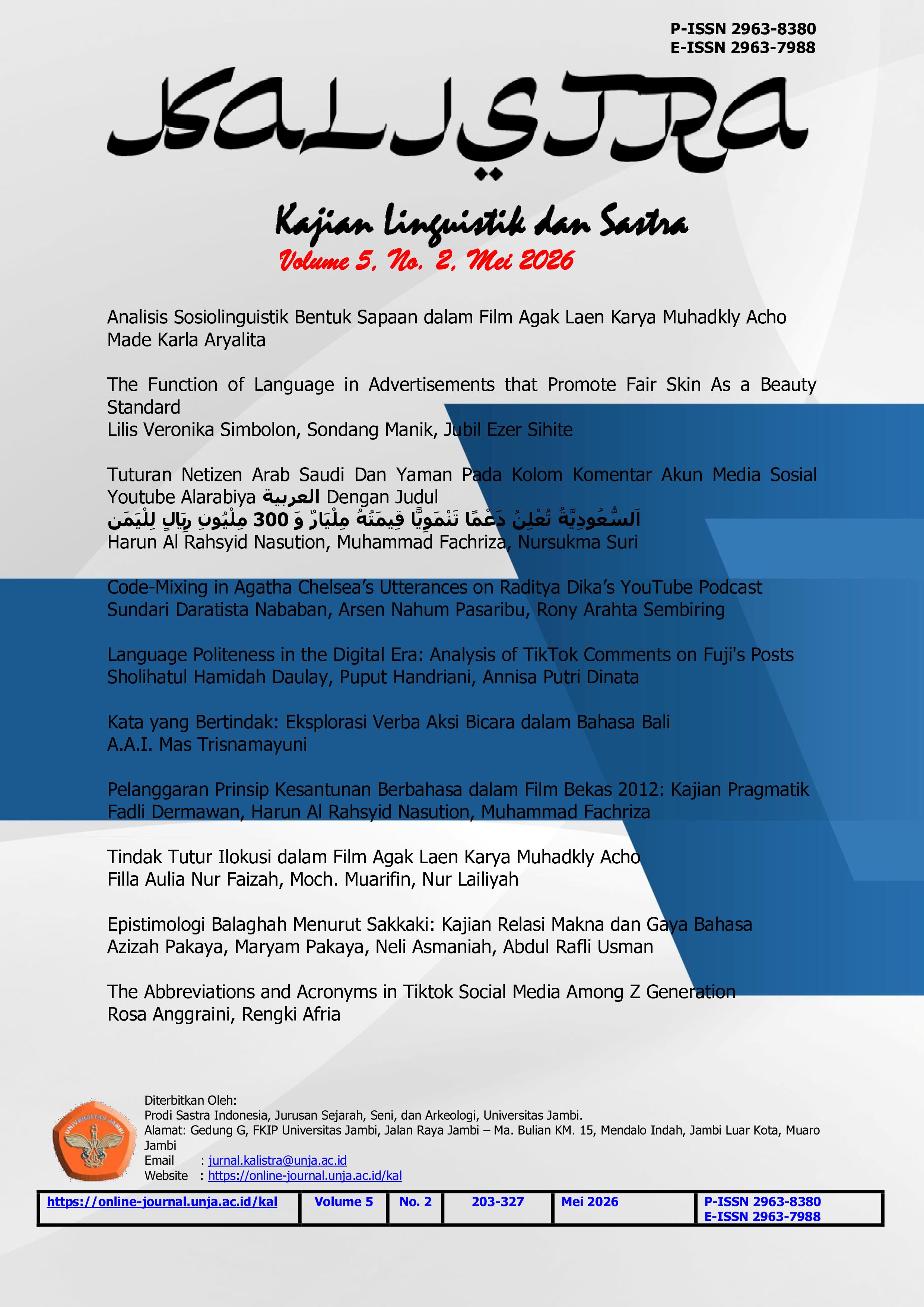
The Function of Language in Advertisements that Promote Fair Skin as a Beauty Standard
DOI:
https://doi.org/10.22437/kalistra.v5i2.54332Kata Kunci:
Language function, beauty advertisement, fair skin, Jakobson, sociolinguisticsAbstrak
This study examines the role of language in beauty advertisements that promote fair skin as a beauty standard. It aims to identify the language functions used and to explain how these functions contribute to the construction of fair skin as an ideal of beauty. The problem of this study focuses on how language is used to influence and shape audience perceptions in advertising discourse. This research employs a descriptive qualitative method. The data consist of 20 beauty advertisements collected from TikTok and YouTube, focusing on verbal elements such as slogans and persuasive expressions. The analysis is based on Roman Jakobson’s theory of language functions. The findings show that the conative function is the most dominant, followed by poetic and emotive functions. Overall, the study reveals that language in beauty advertisements plays a significant role in constructing and reinforcing fair skin as a beauty standard.
Abstrak
Penelitian ini mengkaji peran bahasa dalam iklan kecantikan yang mempromosikan kulit putih sebagai standar kecantikan. Penelitian ini bertujuan untuk mengidentifikasi fungsi-fungsi bahasa yang digunakan serta menjelaskan bagaimana fungsi-fungsi tersebut berkontribusi dalam pembentukan kulit putih sebagai ideal kecantikan. Permasalahan dalam penelitian ini berfokus pada bagaimana bahasa digunakan untuk memengaruhi dan membentuk persepsi audiens dalam wacana periklanan. Penelitian ini menggunakan metode deskriptif kualitatif. Data penelitian terdiri dari 20 iklan kecantikan yang dikumpulkan dari TikTok dan YouTube, dengan fokus pada unsur verbal seperti slogan dan ungkapan persuasif. Analisis didasarkan pada teori fungsi bahasa Roman Jakobson. Hasil penelitian menunjukkan bahwa fungsi konatif merupakan yang paling dominan, diikuti oleh fungsi puitik dan emotif. Secara keseluruhan, penelitian ini mengungkapkan bahwa bahasa dalam iklan kecantikan memainkan peran penting dalam membangun dan memperkuat kulit putih sebagai standar kecantikan.
Unduhan
Referensi
Ahmad, Y., & Aliyu, M. M. (2025). Critical discourse analysis of linguistic and visual elements of GIV soap advertisements. Indonesian Journal of EFL and Linguistics, 21–30.
Akromah, M. (2025). The analysis of ideational and interpersonal meaning in Make Over advertisement. Journal of Curriculum Indonesia, 8(1), 252–257.
Anwar, M. S., & Liaqat, A. (2025). Exploring the construction of ideologies and identities in beauty advertisements through linguistic analysis. Pakistan Languages and Humanities Review, 9(2), 343–355. https://doi.org/10.47205/plhr.2025(9-II)28
Basir, S., Ishak, N. K., Abdullah, R., Bakar, M. H. A., & Sahak, S. Z. (2022). The standards of beauty in the digital era. International Journal of Academic Research in Business and Social Sciences.
Bondarenko, V., & Vyshnivska, B. (2023). Promotional marketing as a method of increasing sales. Three Seas Economic Journal, 4(2), 21–28.
Bozhko, Y. O. (2025). The language of advertising: A tool for teaching English.
Bukhari, M., & Azam, T. (2025). Language and women empowerment: A semiotic analysis of Pakistani advertisement. Pakistan Languages and Humanities Review, 9(1), 400–401.
Burr, V. (2024). Social constructionism (4th ed.). Routledge.
Campbell, C., Sands, S., McFerran, B., & Mavrommatis, A. (2025). Diversity representation in advertising. Journal of the Academy of Marketing Science, 53(2), 588–616.
Catu, S. Y. M., De Lima, P. A. R., & dela Cruz, G. C. P. (2025). Brown beauty, white standards: A linguistic analysis of skin-whitening advertisements in the Philippines.
De Lenne, O., Vandenbosch, L., Smits, T., & Eggermont, S. (2021). Framing real beauty: A framing approach to the effects of beauty advertisements on body image and advertising effectiveness. Body Image, 37, 255–268.
Edouihri, A. Y. M. (2024). The discourse of advertising: The power of language. International Journal of Research in Education, Humanities and Commerce, 5(1), 1–8.
Haasrin, H., & Sidik, E. T. S. (2023). Language and beauty standard ideology in cosmetic advertisements: A critical discourse analysis. Journal of English Language Teaching and Linguistics.
Holmes, J., & Wilson, N. (2022). An introduction to sociolinguistics (6th ed.). Routledge.
Jakobson, R. (1960). Closing statement: Linguistics and poetics. In T. A. Sebeok (Ed.), Style in language (pp. 350–377). MIT Press.
Kozyr, Y. (2024). Language representation of gender and age features of the concept “beauty” in English cosmetics advertising texts. Scientific Journal of Polonia University, 66(6). https://doi.org/10.23856/6711
Noreen, T., & Kamran, F. (2024). Socio-cultural influences and media portrayal of the concept of beauty for women. Pakistan Journal of Applied Psychology, 4(1), 451–467.
Saeed, L., & Khan, S. I. (2022). Critical discourse analysis of language and visuals in beauty advertisements. Global Digital and Print Media Review, 5(2), 37–43. http://dx.doi.org/10.31703/gdpmr.2022(V-II).04
Sembiring, Y. L. B., Sibarani, B., & Sihombing, L. (2020). Language characteristics of beauty product advertisements. Language, 17(1).
Sumarna, N., & Kadriah, N. (2023). Qualitative research methodology. Research Journal.
Syahputri, D., et al. (2023). Research methodology for linguistics and literature. Penerbit Universitas.
Tektigul, Z., Bayadilova-Altybayev, A., Sadykova, S., Iskindirova, S., Kushkimbayeva, A., & Zhumagul, D. (2023). Language as a symbol system that carries culture. International Journal of Society, Culture & Language, 11(1), 203–214.
Yip, J., Ainsworth, S., & Dabaja, I. (2025). Constructing Indonesian beauty ideals through an indigenous beauty brand. Journal of Historical Research in Marketing, 17(3–4), 249–288.
Unduhan
Diterbitkan
Cara Mengutip
Terbitan
Bagian
Lisensi
Hak Cipta (c) 2026 Lilis Veronika Simbolon, Sondang Manik, Jubil Ezer Sihite

Artikel ini berlisensiCreative Commons Attribution-ShareAlike 4.0 International License.
Kalistra: Kajian Linguistik dan Sastra is licensed under Creative Commons Attribution-ShareAlike 4.0 International License.

Authors who publish their manuscripts in Kajian Linguistik dan Sastra agree to the following terms:
1. The copyright in each article belongs to the author.
2. The author acknowledges that Kajian Linguistik dan Sastra reserves the right to be the first to publish under a Creative Commons Attribution-ShareAlike 4.0 International License (Attribution 4.0 International CC BY-SA 4.0).
3. Authors may submit articles separately, arranging for non-exclusive distribution of manuscripts that have been published in this journal to other versions (e.g., delivery to the author's institutional repository, publication into a book, etc.), acknowledging that the manuscript has been first published in Kajian Linguistik dan Sastra.