
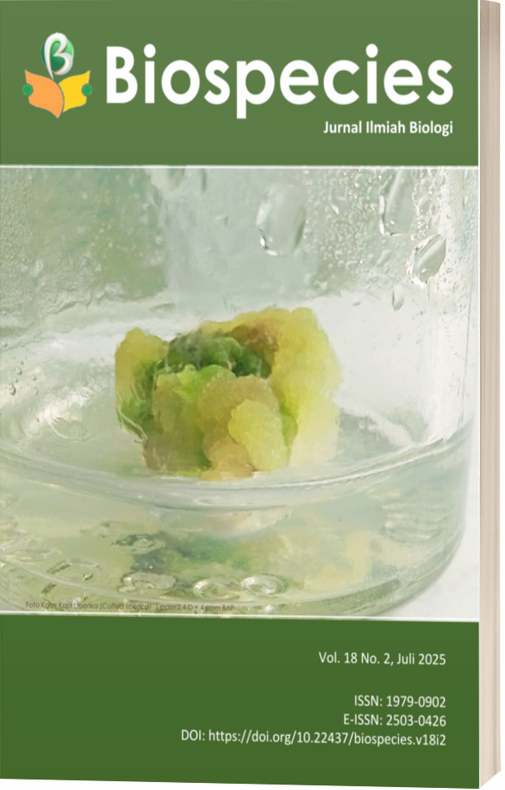
Optimization of Growth Regulators 2,4-D and BAP on the Proliferation of Liberica Coffee Callus (Coffea liberica) in Vitro.
DOI:
https://doi.org/10.22437/biospecies.v18i2.44922Keywords:
2,4-D; BAP; callus; Liberica loffee; Tissue cultureAbstract
Coffee is one of the strategic plantation commodities that has high economic value and an important role in the national economy. Among the various types of coffee cultivated in Indonesia, Coffea liberica has great development potential, especially in areas such as Jambi Province. However, conventional propagation of Liberica coffee plants through seeds or
cuttings still faces obstacles, such as low success rates and slow growth rates. Therefore, tissue culture techniques are an alternative solution to produce Liberika coffee seedlings in bulk, quickly, and uniformly. This study aims to optimize the effect of growth regulator (ZPT) concentration interaction of auxin (2,4-D) and cytokinin (BAP) on liberica coffee callus
formation in vitro. Experiments were conducted at the Plant Biotechnology Laboratory, Jambi University, using a factorial completely randomized design (CRD) with two factors. The first factor is the concentration of 2,4-D which consists of two levels, namely 1 ppm (d1) and 2 ppm (d2). The second factor is the concentration of BAP which consists of five levels, namely 1 ppm (b1), 2 ppm (b2), 3 ppm (b3), 4 ppm (b4), and 5 ppm (b5). Parameters observed included color, structure, size, and callus weight after 12 weeks of culture. The results showed that the interaction between 2,4-D and BAP significantly affected all observation parameters. Callus with the highest size (2.66 cm) and weight (2.90 g) were obtained in the combination of 1 ppm 2,4-D + 4 ppm BAP and 2 ppm 2,4-D + 1 ppm BAP respectively. The callus was yellowishwhite to green and had a crumbly or compact structure, depending on the ZPT combination. In conclusion, a balanced combination of ZPT concentrations greatly determines the success of Liberika coffee callus proliferation, and the results of this study provide an essential basis for the development of efficient coffee tissue culture.
Downloads
Downloads
Published
How to Cite
Issue
Section
License
Authors retain copyright and grant the journal the right of first publication with the work simultaneously licensed under a Creative Commons Attribution 4.0 International License that allows others to share the work with acknowledgment of the work’s authorship and initial publication in this journal.


