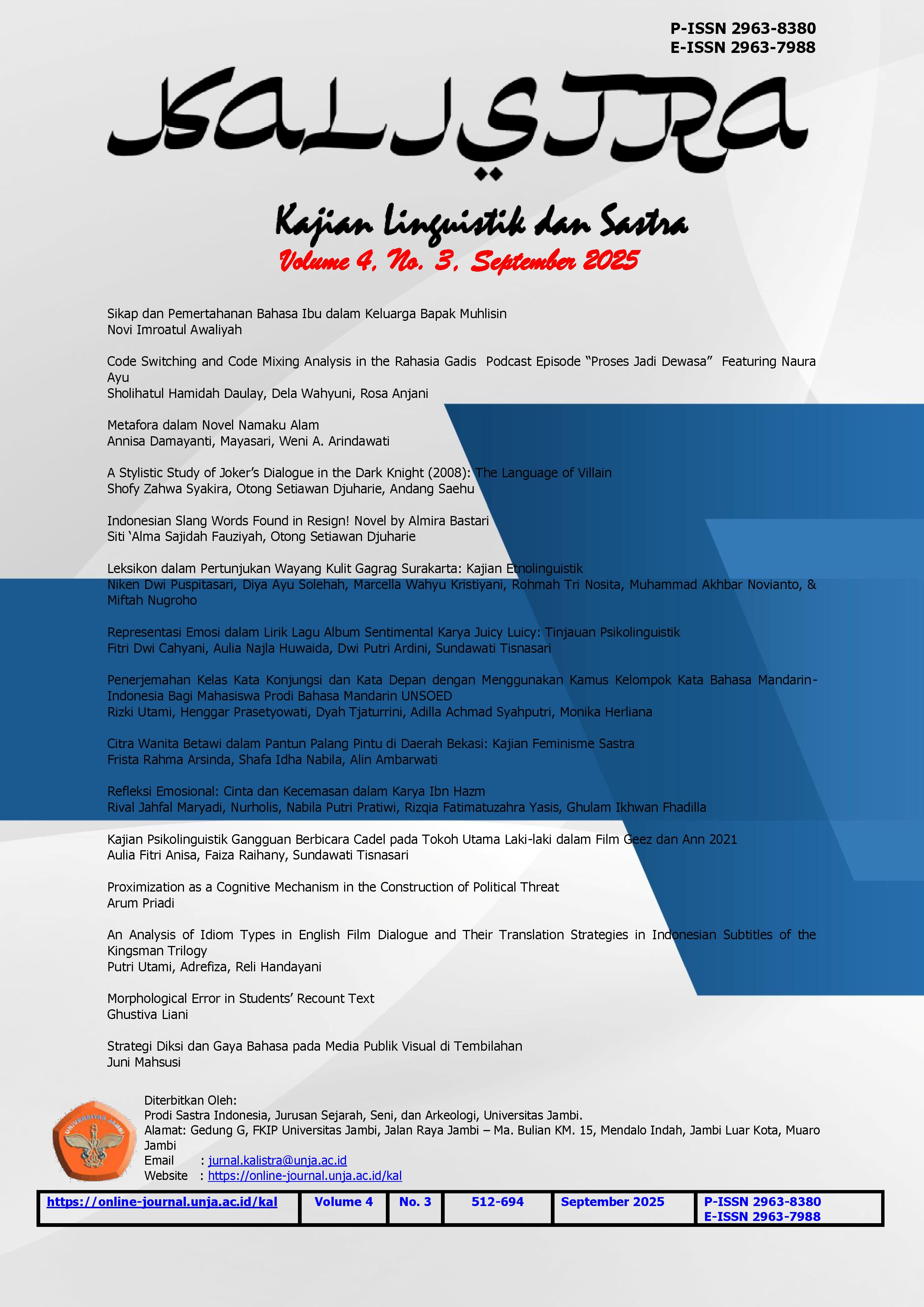
Proximization as a Cognitive Mechanism in the Construction of Political Threat
DOI:
https://doi.org/10.22437/kalistra.v4i3.50084Keywords:
spatial proximization, temporal proximization, axiological proximization, discourse space, policy legitimationAbstract
This study investigates how political discourse constructs a sense of threat through the cognitive–pragmatic process of proximization. Addressing the methodological gap in Critical Discourse Studies (CDS), it integrates Proximization Theory with Discourse Space Theory (DST) to explain how linguistic strategies collapse symbolic distance and legitimize political action. DST provides the socio-cognitive framework through which proximization operates along spatial, temporal, and axiological dimensions. Using a socio-cognitive discourse-analytic design, the study analyzes a political speech by Benjamin Netanyahu (UN General Assembly, 2025), coding each clause for its proximization function. Statistical results (χ²(2) = 25.47, p < .001) indicate a non-random distribution of proximization markers, dominated by axiological cues. These findings demonstrate that spatial contraction, temporal acceleration, and moral intensification jointly construct a trajectory moving the “Other” toward the deictic center, thereby reinforcing ideological alignment and legitimizing political intervention. The study contributes theoretically by integrating DST and proximization into a unified model of ideological cognition, methodologically by combining qualitative mapping and quantitative validation, and practically by illuminating how political actors linguistically manage perception of threat and legitimacy in global diplomacy.
Downloads
References
Abdelwahab, D., San-Martín, S., & Jiménez, N. (2023). Will You Support or Oppose? The Impact of Region-of-Origin Bias on Oppositional Loyalty. Journal of International Consumer Marketing, 35(3). https://doi.org/10.1080/08961530.2022.2108182
Abuarrah, S. (2016). ‘Now’: a marker to a different mental representation and proximization of threat. Acta Linguistica Hafniensia, 48(2). https://doi.org/10.1080/03740463.2016.1216774
Ahmed, Y. (2021). Political discourse analysis: a decolonial approach. Critical Discourse Studies, 18(1). https://doi.org/10.1080/17405904.2020.1755707
Antinyan, A., Bassetti, T., Corazzini, L., & Pavesi, F. (2021). Political Narratives and the US Partisan Gender Gap. Frontiers in Psychology, 12. https://doi.org/10.3389/fpsyg.2021.675684
Cap, P. (2008). Towards the proximization model of the analysis of legitimization in political discourse. Journal of Pragmatics, 40(1), 17–41. https://doi.org/10.1016/j.pragma.2007.10.002
Cap, P. (2010). Axiological aspects of proximization. Journal of Pragmatics, 42(2). https://doi.org/10.1016/j.pragma.2009.06.008
Cap, P. (2014). Proximization Theory and Critical Discourse Studies: A Promising Connection? International Review of Pragmatics, 5(2), 293–317. https://doi.org/10.1163/18773109-13050208
Cap, P. (2017). Studying ideological worldviews in political Discourse Space: Critical-cognitive advances in the analysis of conflict and coercion. Journal of Pragmatics, 108. https://doi.org/10.1016/j.pragma.2016.11.008
Chilton, P. (2010). The conceptual structure of deontic meaning: A model based on geometrical principles. Language and Cognition, 2(2), 191–220. https://doi.org/10.1515/langcog.2010.008
Denning, K. R., & Hodges, S. D. (2022). When Polarization Triggers Out-Group “Counter-Projection” Across the Political Divide. Personality and Social Psychology Bulletin, 48(4). https://doi.org/10.1177/01461672211021211
Dinu, L. P., & Uban, A. S. (2023). Analyzing Stylistic Variation Across Different Political Regimes. Lecture Notes in Computer Science (Including Subseries Lecture Notes in Artificial Intelligence and Lecture Notes in Bioinformatics), 13396 LNCS. https://doi.org/10.1007/978-3-031-23793-5_10
Federico, C. M., & Malka, A. (2023). THE PSYCHOLOGICAL AND SOCIAL FOUNDATIONS OF IDEOLOGICAL BELIEF SYSTEMS. In The Oxford Handbook of Political Psychology, Third Edition. https://doi.org/10.1093/oxfordhb/9780197541302.013.16
Georgakopoulou, A. (2008). “On MSN with buff boys”: Self- and other-identity claims in the context of small stories. Journal of Sociolinguistics, 12(5). https://doi.org/10.1111/j.1467-9841.2008.00384.x
Gilbert, K. (2015). Methodology in Writing Research: Towards a Socio-Cognitive Analysis of Argumentation in Students’ Academic Discourse. Transcultural Studies, 1(1). https://doi.org/10.1163/23751606-00101002
Hassan, I. H. (2000). Language, gender, and power: Analysis of theme and topic management in Arabic conversational discourse. The Humanities and Social Science, 61.
Israeli Prime Minister Benjamin Netanyahu Addresses The United Nations General Assembly. (2025). https://www.youtube.com/watch?v=nD2zuzj9TqY
Ke, X., & Zou, S. (2023). An empirical study on court-related mediator’s discourse strategies from the perspective of proximization: Based on a workplace injury pretrial mediation case. Discourse and Society, 34(3). https://doi.org/10.1177/09579265221149530
Korkeamäki, L., & Kohtamäki, M. (2020). To outcomes and beyond: Discursively managing legitimacy struggles in outcome business models. Industrial Marketing Management, 91. https://doi.org/10.1016/j.indmarman.2020.08.023
Kovanic, M. (2021). The construction of threats by intelligence agencies: analysing the language of official documents in Slovakia. Critical Studies on Terrorism, 14(1). https://doi.org/10.1080/17539153.2021.1876548
Liuzza, M. T., Cazzato, V., Vecchione, M., Crostella, F., Caprara, G. V., & Aglioti, S. M. (2011). Follow my eyes: The gaze of politicians reflexively captures the gaze of ingroup voters. PLoS ONE, 6(9). https://doi.org/10.1371/journal.pone.0025117
Moody, S., & Eslami, Z. R. (2020). Political discourse, code‐switching, and ideology. Russian Journal of Linguistics, 24(2). https://doi.org/10.22363/2687-0088-2020-24-2-325-343
Priadi, A. (2025a). Constructing Moral Legitimacy Through Empathic and Inferential Strategies in Political Discourse Toward a Cognitive Pragmatic Model of Diplomatic Persuasion. 1(2), 20–30.
Priadi, A. (2025b). Linguistic Manipulation in Gendered Political Campaigns : A Pragmatic Analysis of Suggestion in the Discourse of Female Leadership in Indonesia. 1(1), 67–89.
Risse, T. (2024). External threats and state support for arms control. Journal of Peace Research, 61(2). https://doi.org/10.1177/00223433221123359
Ruth Wodak (ed), P. A. C. (ed). (2005). A New Agenda in (Critical) Discourse Analysis. 3–18. https://doi.org/10.1075/dapsac.13.04lee
Salama, A. H. Y. (2022). CROSS-TEXTUAL RECONCEPTUALISATION OF THE DEICTIC SPACE OF “VICTORY” IN POLITICAL DISCOURSE: DONALD TRUMP VERSUS JOSEPH BIDEN. Discourse and Interaction, 15(1). https://doi.org/10.5817/DI2022-1-101
Sánchez Medero, R. (2021). Democratization in Political Communication. Political Studies Review, 19(4). https://doi.org/10.1177/1478929920924930
Scholtz, M. (2019). Does a small community (town) benefit from an international event? Tourism Management Perspectives, 31. https://doi.org/10.1016/j.tmp.2019.05.006
Sorensen, L. (2024). Populist disruption and the fourth age of political communication. European Journal of Communication, 39(1). https://doi.org/10.1177/02673231231184702
Vaara, E., Aranda, A. M., & Etchanchu, H. (2024). Discursive Legitimation: An Integrative Theoretical Framework and Agenda for Future Research. In Journal of Management (Vol. 50, Issue 6). https://doi.org/10.1177/01492063241230511
Van Dijk, T. A. (1993). Principles of critical discourse analysis. Discourse & Society, 4(2). https://doi.org/10.1177/0957926593004002006
Wang, Y. (2019). Proximization theory and the construction of international values: A case study of president xi jinping’s speech at the 70th session of the un general assembly. Journal of Language Teaching and Research, 10(6). https://doi.org/10.17507/jltr.1006.24
Wodak, R., & Kendall, G. (2007). What is critical discourse analysis? In Forum Qualitative Sozialforschung (Vol. 8, Issue 2).
Wu, S. S. (2023). Taiwan’s security: Civilian control and external threat. Cogent Arts and Humanities, 10(1). https://doi.org/10.1080/23311983.2023.2220211
Ye, H., & Chen, K. (2023). A study on the discourse strategy of telecommunication fraud based on proximization theory. Discourse and Communication, 17(2). https://doi.org/10.1177/17504813221129517
Zhang, X. (2023). Study on Approaching Critical Discourse Analysis. Journal of Education, Humanities and Social Sciences, 7. https://doi.org/10.54097/ehss.v7i.3998
Downloads
Published
How to Cite
Issue
Section
License
Copyright (c) 2025 Arum Priadi

This work is licensed under a Creative Commons Attribution-ShareAlike 4.0 International License.
Kalistra: Kajian Linguistik dan Sastra is licensed under Creative Commons Attribution-ShareAlike 4.0 International License.

Authors who publish their manuscripts in Kajian Linguistik dan Sastra agree to the following terms:
1. The copyright in each article belongs to the author.
2. The author acknowledges that Kajian Linguistik dan Sastra reserves the right to be the first to publish under a Creative Commons Attribution-ShareAlike 4.0 International License (Attribution 4.0 International CC BY-SA 4.0).
3. Authors may submit articles separately, arranging for non-exclusive distribution of manuscripts that have been published in this journal to other versions (e.g., delivery to the author's institutional repository, publication into a book, etc.), acknowledging that the manuscript has been first published in Kajian Linguistik dan Sastra.