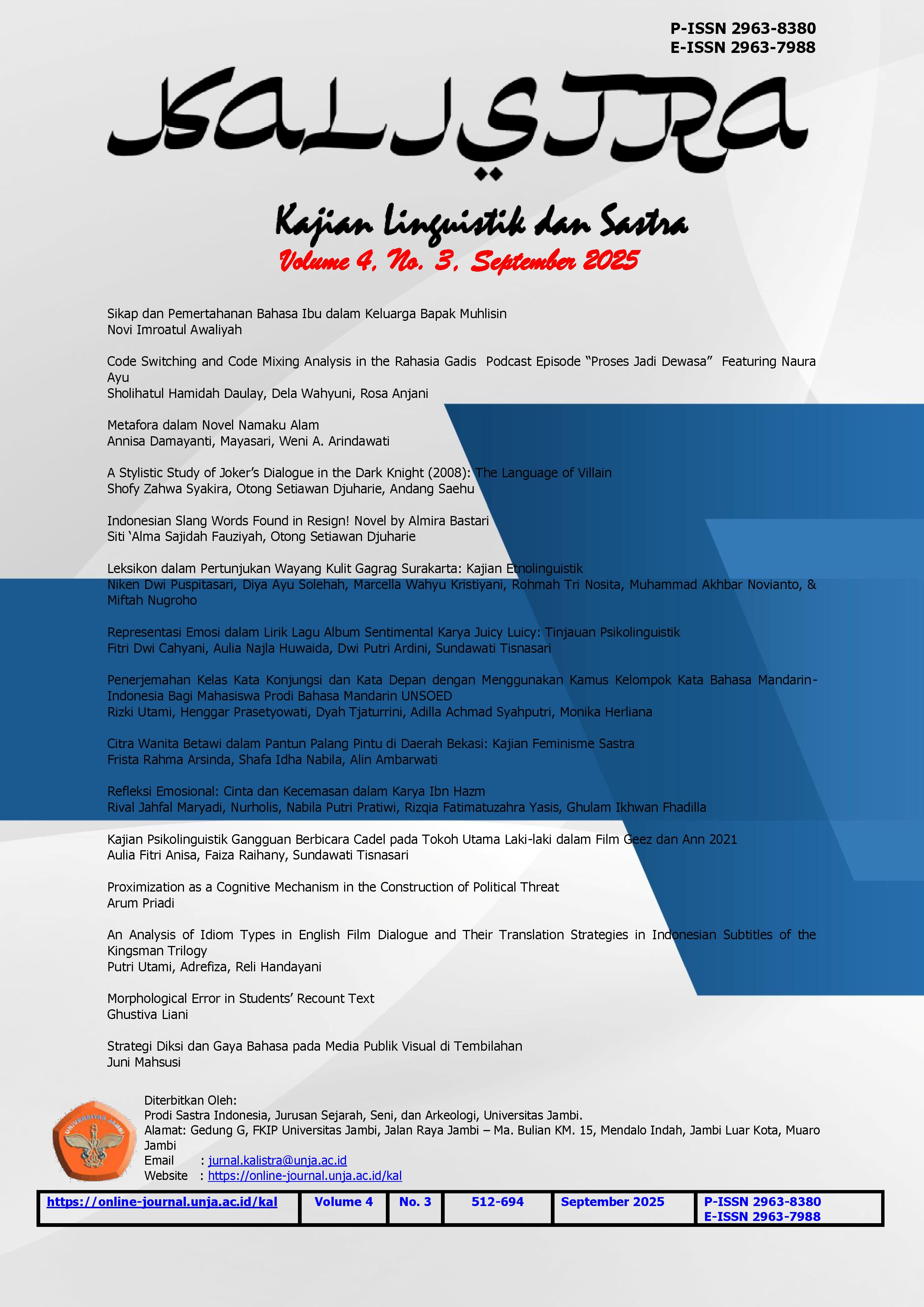
Indonesian Slang Words Found in Resign! Novel by Almira Bastari
DOI:
https://doi.org/10.22437/kalistra.v4i3.45817Keywords:
Slang, Novel, Resign!, Particles, MetropopAbstract
This research aims to analyze Indonesian slang in the novel Resign!, one of the Metropop works. In the Resign! novel, slang is utilized to shape characters, create dynamic and lively dialogues, and establish emotional closeness between the characters particularly using abbreviation/acronym, coinage, clipping, and semantic shift types of slang. This study used a descriptive qualitative method with a case study approach. Data were obtained through close reading, note-taking, categorization, and analysis of 40 slang expressions found in the novel. The research also reveals the use of uniquely Indonesian particles such as “dong”, “kok”, and “sih”, which enhance the informal and familiar tone of the text. The results indicate that the use of slang in this novel not only enriches the language style, but also reflects the influence of popular culture and the social reality of urban youth, which serve as the novel’s backdrop.
Abstrak
Penelitian ini bertujuan untuk menganalisis bahasa gaul Indonesia dalam novel Resign!, salah satu karya Metropop. Dalam novel Resign!, bahasa gaul digunakan untuk membentuk karakter, menciptakan dialog yang dinamis dan hidup, serta membangun kedekatan emosional antara karakter-karakter tersebut, terutama dengan menggunakan jenis bahasa gaul seperti singkatan/akronim, penciptaan kata baru, pemotongan, dan pergeseran makna. Studi ini menggunakan metode kualitatif deskriptif dengan pendekatan studi kasus. Data diperoleh melalui pembacaan mendalam, pencatatan, kategorisasi, dan analisis terhadap 40 ungkapan slang yang ditemukan dalam novel tersebut. Penelitian ini juga mengungkapkan penggunaan partikel unik Indonesia seperti “dong”, “kok”, dan “sih”, yang meningkatkan nada informal dan akrab dari teks tersebut. Hasil penelitian menunjukkan bahwa penggunaan bahasa gaul dalam novel ini tidak hanya memperkaya gaya bahasa, tetapi juga mencerminkan pengaruh budaya populer dan realitas sosial kaum muda perkotaan, yang menjadi latar belakang novel tersebut.
Downloads
References
Allan, K., & Burridge, K. (2006). Forbidden Words: Taboo and the Censoring of Language. Cambridge University Press.
Alya Namira, M. Kiki Wardana, & Misla Geubrina. (2024). Slang Words In Free Guy Movie By Matt Lieberman : Sociolinguistics Approach. Fonologi : Jurnal Ilmuan Bahasa Dan Sastra Inggris, 2(1), 157–167. https://doi.org/10.61132/fonologi.v2i1.403
Bashir, S. (2015). Coinage As Linguistic Innovation Among Members of Alaramma. November.
Bastari, A. (2018). Resign! Penerbit Gramedia Pustaka Umum.
Budiasa, I. G., Weddha Savitri, P., & Shanti Sari Dewi, A. A. S. (2021). Penggunaan Bahasa Slang di Media Sosial. Humanis, 25(2), 192. https://doi.org/10.24843/jh.2021.v25.i02.p08
Dawis, A. M., Meylani, Y., Heryana, N., Alfathoni, M. A. M., Sriwahyuni, E., Ristiyana, R., Januarsi, Y., Wiratmo, P. A., Dasman, S., Mulyani, S., Agit, A., Shoffa, S., & Baali, Y. (2023). Pengantar Metodologi Penelitian.
Degaf, A., Irham, N., & Rofiq, Z. (2020). Sebuah Reviu terhadap Kajian Partikel Pragmatik dalam Beberapa Bahasa Daerah di Indonesia. Ranah: Jurnal Kajian Bahasa, 9(1), 1. https://doi.org/10.26499/rnh.v9i1.1411
Harared, N. (2018). SLANG CREATED AND USED IN 1CAK . COM SITE : A SOCIOLINGUISTICS STUDY. 58, 119–127.
Kasitha, N. P. R. A., & Ida Ayu, P. G. A. (2022). an Analysis of Compounding and Clipping Slang Words Found in “After We Collided” Movie. SPHOTA: Jurnal Linguistik Dan Sastra, 14(2), 127–134. https://doi.org/10.36733/sphota.v14i2.5030
L.R.Trask. (1999). The Basic Langusge.
Mahardika, F. (2023). the Impact of Social Media on the Use of English Slang. Prosiding Seminar Nasional Bahasa, Sastra, Seni, Dan Pendidikan Dasar (SENSASEDA), 3(1), 87–90.
Miyake, Y. (2015). Pragmatic particles and information structure in colloquial Indonesian dialogue. Ilcaa, Tufs, 103-114. http://hdl.handle.net/10108/84512
Napitu, F. E. (n.d.). AN ANALYSIS OF SLANG WORDS ABBREVIATION IN AMERICAN CAPTION ON INSTAGRAM : A SOCIOLINGUISTICS APPROACH This research is a study of language phenomena that occurs in social media . Instagram users often take action to upload pictures , videos , and memes b.
Nasution, S. S., Karimah, L. J., Sitepu, S. S. W., Tryana, T., & Kusumoriny, L. A. (2021). Slang Words in Me, and Earl, and The Dying Girl Novel: Type and Interpretation. Eralingua: Jurnal Pendidikan Bahasa Asing Dan Sastra, 5(1), 208. https://doi.org/10.26858/eralingua.v5i1.14069
Nuraini, F. W., & Pahamzah, J. (2021). an Analysis of Slang Language Used in Teenager. Litera, 20(2), 313–322.
Practice, T., & Culture, I. (2024). THE 3 rd INTERNATIONAL SYMPOSIUM on The Practice of Coexistence in Islamic Culture. 1(October).
Rahman, O. S., Sobarna, C., Sujatna, E. T. S., & Indriyani, L. M. (2022). Semantic Shift of English Internet Slangs Used in Social Media: Morphosemantic Analysis. Research and Innovation in Language Learning, 5(1), 79. https://doi.org/10.33603/rill.v5i1.6387
Roth‐Gordon, J. (2020). Language and Creativity: Slang. The International Encyclopedia of Linguistic Anthropology, 1–8. https://doi.org/10.1002/9781118786093.iela0192
Wardhani, A. D. W. (2023). Analisis Bahasa Slang Dalam Novel Dikta dan Hukum Karya Dhia’an Farah. Deiksis, 15(3), 278. https://doi.org/10.30998/deiksis.v15i3.20979
Willie Tan. (2022). Research Methods: A Practical Guide For Students And Researchers (Second Edition). World Scientific.
Yulianti, H. (2023). Analisis Ragam Bahasa Gaul Yang Digunakan Remaja Milenial Pada Komentar Di Media Sosial Tiktok. Garuda :Jurnal Pendidikan Kewarganegaraan Dan Filsafat, 1(2), 117–131. https://doi.org/10.59581/jpkf-widyakarya.v1i2.446
Downloads
Published
How to Cite
Issue
Section
License
Copyright (c) 2025 Siti 'Alma Sajidah Fauziyah, Otong Setiawan Djuharie

This work is licensed under a Creative Commons Attribution-ShareAlike 4.0 International License.
Kalistra: Kajian Linguistik dan Sastra is licensed under Creative Commons Attribution-ShareAlike 4.0 International License.

Authors who publish their manuscripts in Kajian Linguistik dan Sastra agree to the following terms:
1. The copyright in each article belongs to the author.
2. The author acknowledges that Kajian Linguistik dan Sastra reserves the right to be the first to publish under a Creative Commons Attribution-ShareAlike 4.0 International License (Attribution 4.0 International CC BY-SA 4.0).
3. Authors may submit articles separately, arranging for non-exclusive distribution of manuscripts that have been published in this journal to other versions (e.g., delivery to the author's institutional repository, publication into a book, etc.), acknowledging that the manuscript has been first published in Kajian Linguistik dan Sastra.